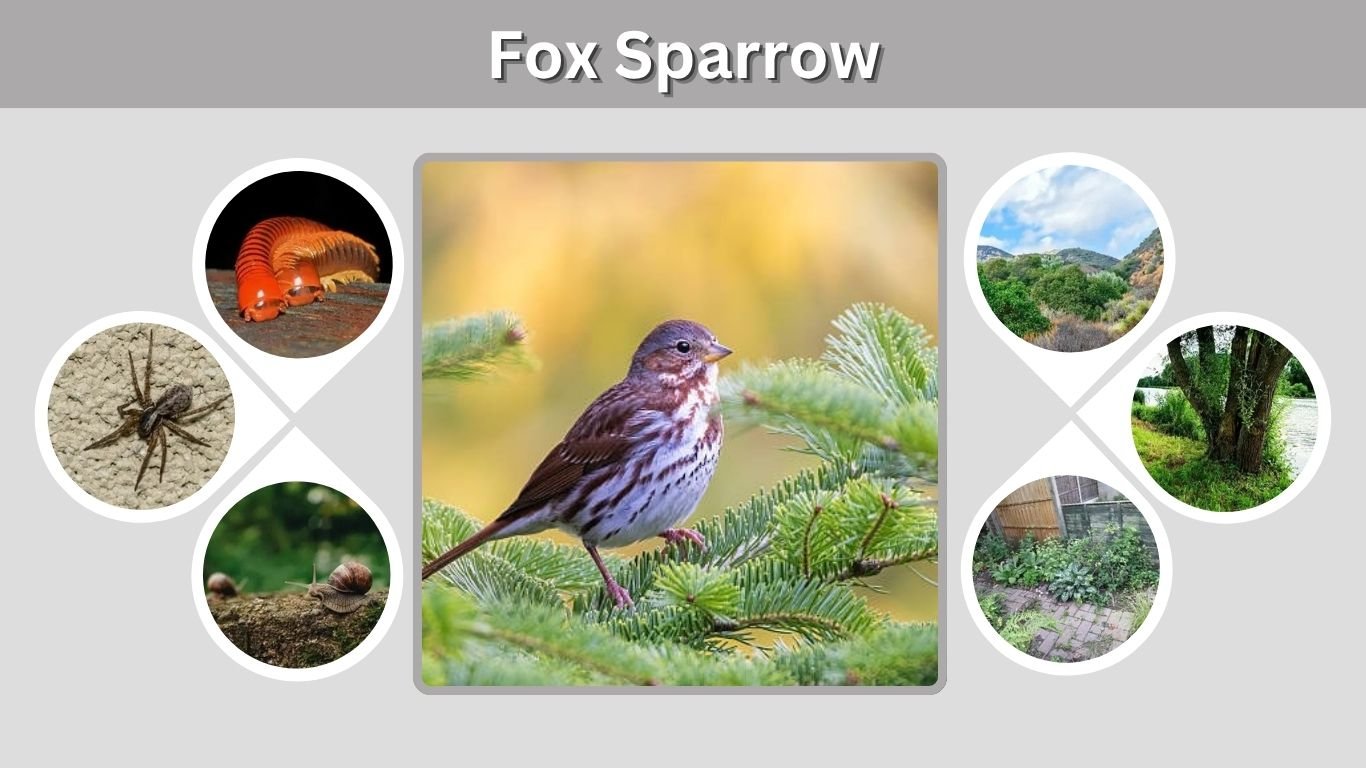
The Fox Sparrow (Passerella iliaca) is a large, heavily marked North American sparrow known for its powerful ground-scratching behavior and rich, musical song. Despite its name, it has no special relationship with foxes; the name refers to the reddish, fox-like coloring shown by many individuals. Fox Sparrows vary considerably across their range, appearing rusty red, gray, brown, or nearly chocolate-colored. They are often easiest to find during migration or winter while searching through leaves beneath dense shrubs.
Fox Sparrow Overview
Fox Sparrows are members of the New World sparrow family, Passerellidae. They breed mainly across northern forests and western mountain regions, while wintering farther south in brushy woodland, chaparral, forest edges, and residential areas with dense cover.
| Feature | Description |
| Scientific name | Passerella iliaca |
| Length | 5.9–7.5 inches |
| Wingspan | 10.5–11.4 inches |
| Weight | 0.9–1.6 ounces |
| Body shape | Large, rounded and chunky |
| Main foods | Insects, seeds, fruits and other invertebrates |
| Habitat | Dense thickets, forests, chaparral and mountain scrub |
| Migration | Short- to long-distance migrant |
Measurements vary among the regional forms, but Fox Sparrows are generally larger and heavier than Song Sparrows, Chipping Sparrows and Dark-eyed Juncos.
Fox Sparrow Identification
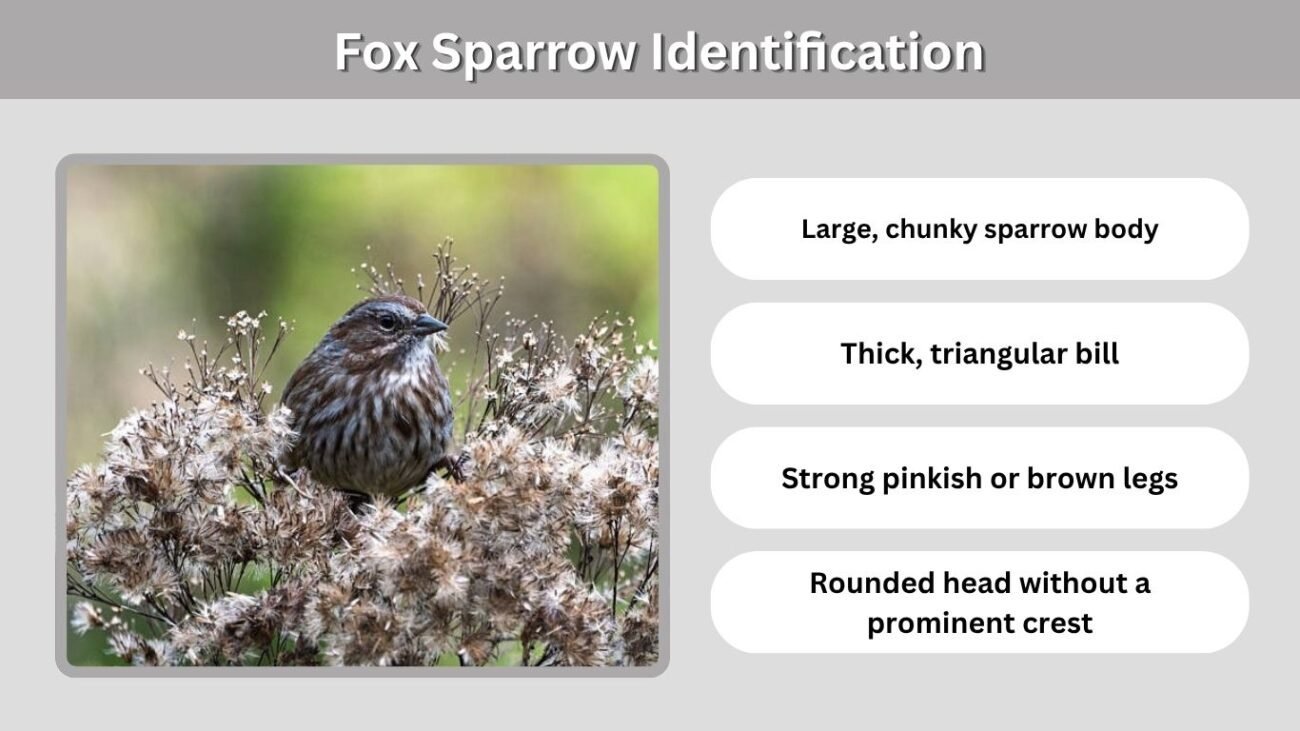
A Fox Sparrow is a large, round-bodied sparrow with a rounded head, stout conical bill, medium-length tail and powerful legs. Its breast and sides are covered with bold, blurry spots or arrow-shaped streaks. These marks often converge into a dark central patch on the chest.
Key Identification Features
- Large, chunky sparrow body
- Thick, triangular bill
- Bold spots across the white or grayish breast
- Heavy markings that often meet in the center of the chest
- Rusty, reddish-brown or dark brown tail
- Strong pinkish or brown legs
- Rounded head without a prominent crest
- Habit of scratching vigorously through fallen leaves
The exact color pattern depends on where the bird comes from. Some are bright reddish brown, while others are gray, sooty brown or a mixture of gray and rust. The combination of a bulky body, thick breast markings and energetic ground-foraging behavior is often more useful than color alone.
Male vs Female Fox Sparrow
Male and female Fox Sparrows have nearly identical plumage. Males may average slightly larger, but size is usually not a practical way to determine sex in the field. During the breeding season, a bird singing repeatedly from a shrub or tree is likely to be a male because males use their songs to advertise and defend territories.
Juvenile Fox Sparrow
Juvenile Fox Sparrows resemble adults but generally look duller. Their upperparts may appear less richly colored, while the markings across the breast are often narrower and less blotchy. As the young bird molts, it develops stronger regional colors and heavier breast pattern associated with adults.
Four Main Fox Sparrow Forms
The Fox Sparrow is among North America’s most geographically variable songbirds. Its numerous regional populations are commonly organized into four broad groups, each with a distinctive appearance and distribution.
Red Fox Sparrow
The Red Fox Sparrow is the form most frequently seen across eastern North America during migration and winter. It has a grayish head, reddish-brown back, bright rusty wings and tail, and large reddish marks across its pale underparts. Red Fox Sparrows breed widely through Alaska, Canada and the northern boreal forest.
Sooty Fox Sparrow
Sooty Fox Sparrows are dark brown or chocolate-colored, sometimes with only limited reddish tones. Their dense breast spots may merge into broad dark patches. This group breeds primarily along the Pacific coast from Alaska and British Columbia south toward Washington, then winters farther south along the coast.
Slate-Colored Fox Sparrow
The Slate-colored form has a gray head and back, reddish wings and tail, and dark spots against pale underparts. It breeds in dense mountain and streamside thickets of the Interior West, from parts of British Columbia south toward the central Rocky Mountains.
Thick-Billed Fox Sparrow
The Thick-billed Fox Sparrow resembles the Slate-colored form but has a noticeably deeper and more massive bill. It has a grayish head and back, reddish-brown wings and tail, and heavy dark markings below. It is strongly associated with brushy mountain habitats in California and nearby western regions.
Fox Sparrow Habitat
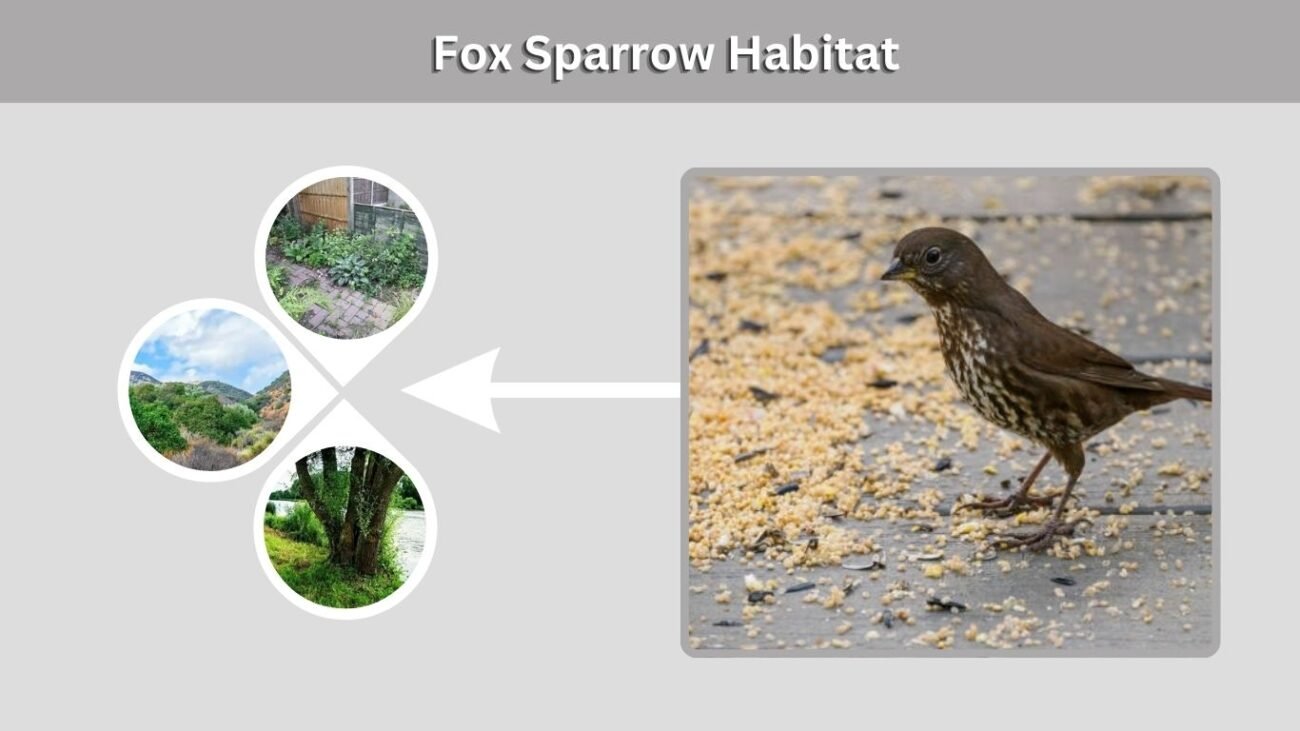
Fox Sparrows depend heavily on dense vegetation. Breeding habitats include coniferous forest edges, willow and alder thickets, streamside shrubs, chaparral, boreal scrub and brush-covered mountain slopes. They usually select areas where thick ground cover provides nesting sites, food and protection from predators.
During migration, Fox Sparrows may appear in open hardwood forests, swampy thickets, woodland edges, hedgerows and overgrown gardens. In winter, they commonly occupy brush piles, forest-floor tangles and shrubs near residential bird feeders. They rarely remain far from cover for long.
Fox Sparrow Range and Migration
Fox Sparrows breed across Alaska, much of Canada and mountainous areas of western North America. Their winter distribution includes the Pacific Coast and large parts of the southern and eastern United States. Many eastern birdwatchers encounter them mainly during fall migration, winter or early spring.
All Fox Sparrow populations migrate, but their journeys vary greatly. Birds breeding in Alaska may travel at night to wintering grounds as far away as Florida. In contrast, some Sierra Nevada populations simply move from high-elevation breeding territories to lower elevations during winter.
What Do Fox Sparrows Eat?
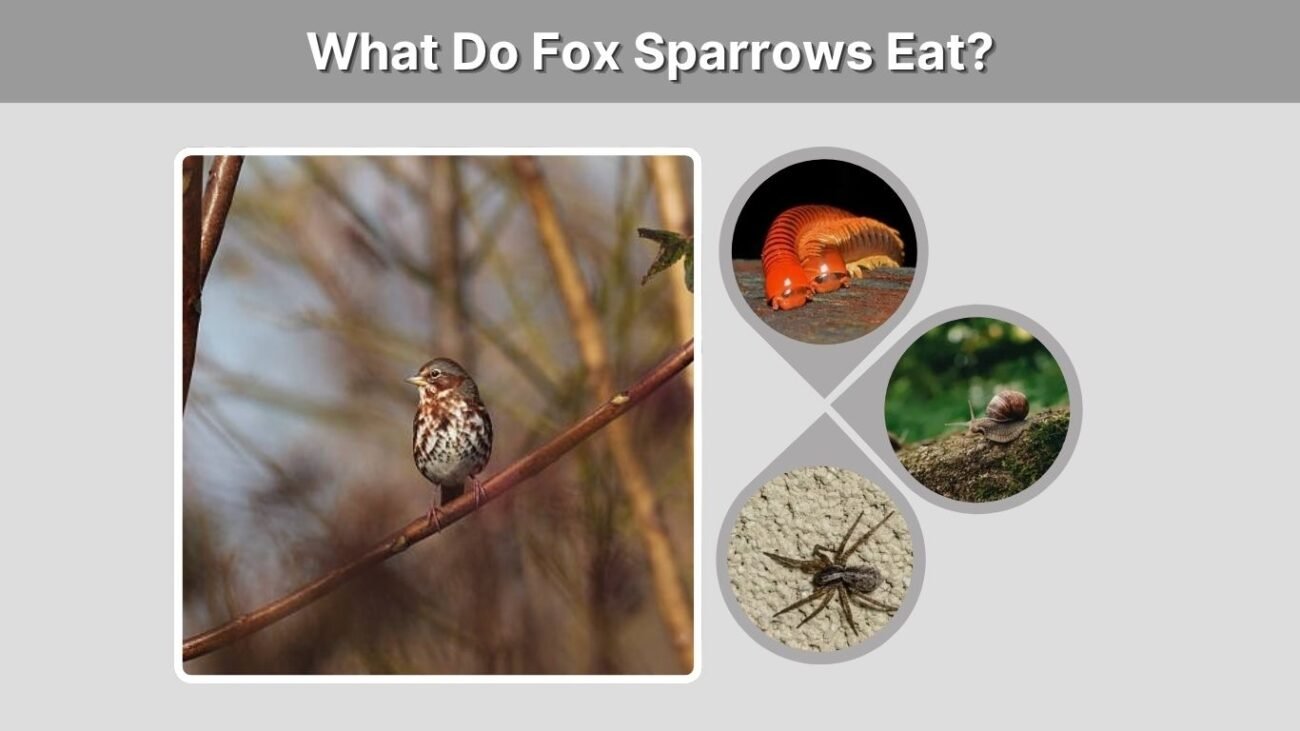
Fox Sparrows are omnivores whose diet changes throughout the year. During the breeding season, they eat numerous insects, including beetles, ants, caterpillars, fly larvae, bees and scale insects. Spiders, millipedes, snails and other small invertebrates are also consumed.
Plant foods become especially important during migration and winter. Fox Sparrows eat grass and weed seeds, buds, berries and fruits from plants such as blackberry, raspberry, strawberry, grape, ragweed, smartweed, sedges and serviceberry. Nestlings are fed mainly protein-rich insects.
Their most recognizable feeding behavior is the double scratch. The bird hops forward and immediately backward while kicking both feet through leaves. This movement throws leaf litter behind the bird and exposes hidden seeds and invertebrates.
Fox Sparrow Song and Call
The Fox Sparrow has a clear, rich song made of musical whistles and smoothly sliding notes. The song can vary geographically, but it is generally fuller and more melodic than the short, repetitive songs of many smaller sparrows. Males often sing from the upper branches of shrubs or trees during the breeding season.
Its common call is a sharp, smacking or metallic “chip.” This call may be heard when a bird is alarmed or when a hidden Fox Sparrow is moving through a thicket. Because these birds spend considerable time beneath vegetation, listening for calls and rustling leaves can be more productive than searching exposed perches.
Nesting, Eggs and Reproduction
Fox Sparrows place their nests on the ground or in low shrubs, small trees and dense chaparral. The female is believed to perform most or all nest construction, using twigs, bark, moss, lichens and coarse grasses. The inner cup is lined with softer materials such as fine grass, roots, hair, feathers and moss.
A typical clutch contains two to five pale bluish-green eggs marked with reddish-brown blotches. Incubation lasts approximately 12–14 days, and the female performs most of it. Both parents feed and protect the young, which normally leave the nest about 9–11 days after hatching.
Fox Sparrow vs Similar Birds
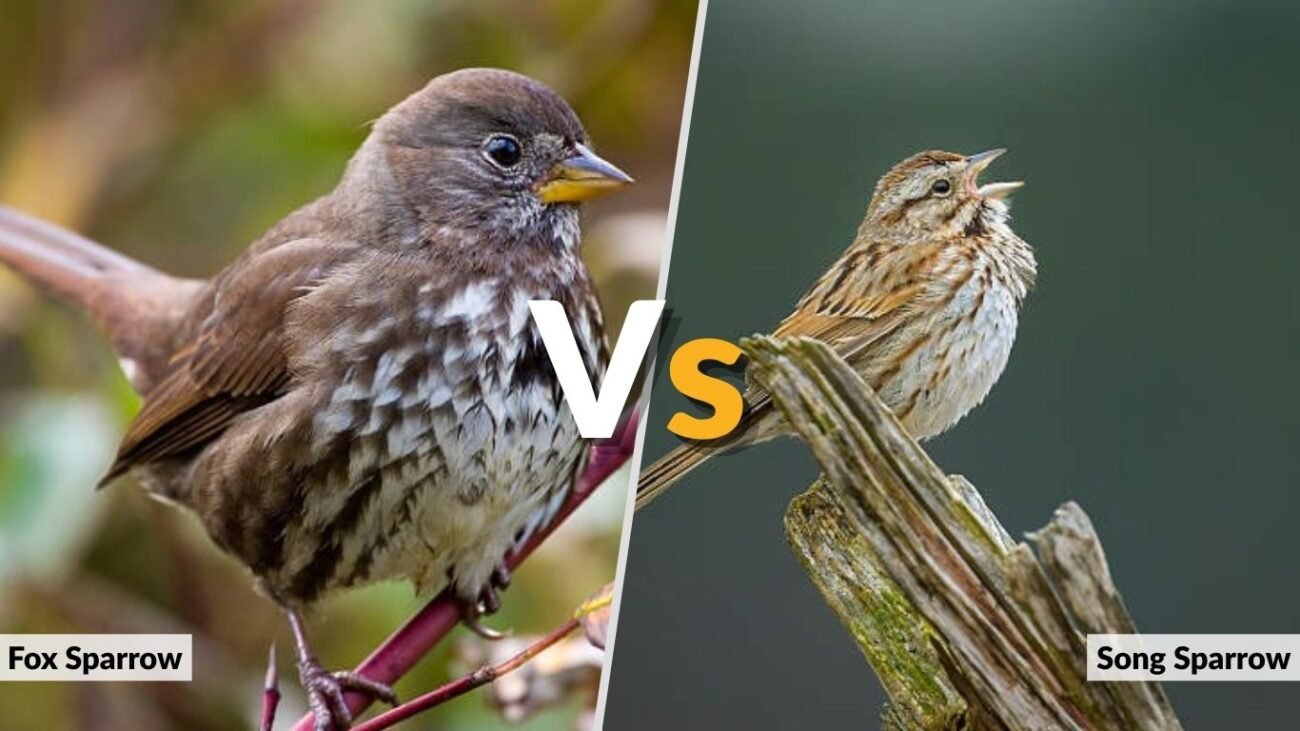
Boldly streaked birds can be challenging to identify, especially when viewed briefly beneath shrubs. Size, marking shape, behavior and habitat can separate a Fox Sparrow from its most common look-alikes.
Fox Sparrow vs Song Sparrow
| Feature | Fox Sparrow | Song Sparrow |
| Size | Larger and heavier | Smaller and slimmer |
| Breast marks | Thick, blurry blotches | Finer, sharper streaks |
| Bill | Stout and heavy | Moderately sized |
| Color | Often strongly reddish or dark brown | Usually gray and brown |
| Feeding | Powerful double scratching | Picks and scratches through ground cover |
| Song | Rich whistles and sliding notes | Varied phrases, usually ending in a trill |
Song Sparrows also have a central chest spot, but their streaks are usually narrower and more clearly defined. Fox Sparrows look rounder and more powerful and often send leaves flying while foraging.
Fox Sparrow vs Hermit Thrush
A Hermit Thrush may share the Fox Sparrow’s reddish tail and spotted breast, but it has a thinner bill, more upright posture, longer legs and rounder breast spots. It also frequently raises and slowly lowers its rusty tail. The Fox Sparrow has a thick seed-cracking bill and heavier markings that form streaks or blotches rather than neat spots.
Predators and Defensive Behavior
Adult Fox Sparrows may be hunted by small falcons and other predatory birds. Their nests are vulnerable to snakes, weasels, chipmunks and additional ground-dwelling predators. When danger approaches a nest, a parent may give alarm calls or perform a broken-wing display to draw attention away from the eggs or chicks.
FAQs
Are Fox Sparrows rare?
Fox Sparrows are not generally rare, but they can be difficult to notice because they prefer dense vegetation and breed in remote northern or mountainous habitats. In many regions, they appear only during migration or winter and may remain concealed while feeding beneath shrubs.
Do Fox Sparrows visit bird feeders?
Fox Sparrows sometimes visit yards, but they usually feed on the ground rather than on elevated feeders. They may scratch for fallen millet, sunflower pieces and other seeds beneath feeders positioned near shrubs, brush piles or woodland cover.
Why is it called a Fox Sparrow?
The name comes from the fox-like reddish or rusty plumage displayed by many individuals, particularly birds in the Red Fox Sparrow group. However, not every Fox Sparrow is red; western forms may be gray, dark brown or sooty in appearance.
How long do Fox Sparrows live?
Many individuals probably live only a few years because of predation, weather and migration hazards. However, bird-banding records have documented a wild Fox Sparrow that survived for at least nine years and eight months.
Do foxes eat Fox Sparrows?
Foxes may occasionally capture small ground-feeding birds, but the bird’s name does not describe a predator-prey relationship. Fox Sparrows are more regularly threatened by predatory birds, snakes, weasels and other animals capable of reaching adults or nests.