











The American Crow (Corvus brachyrhynchos) is one of North America’s most familiar and intelligent birds. Known for its jet-black feathers, sharp calls, and remarkable adaptability, this species thrives in both wilderness and urban landscapes. Revered and feared across cultures, the American Crow has become a fascinating symbol of mystery, transformation, and survival. Its intelligence, social structure, and connection to Native American culture make it an extraordinary subject of study and admiration.
Identification and Classification

Scientific Name and Taxonomy
- Scientific name: Corvus brachyrhynchos
- Family: Corvidae (includes ravens, magpies, jays)
- Genus: Corvus
- Common name: American Crow
- Meaning: “Short-billed crow” (from Latin)
- Relatives: Common Raven (Corvus corax), Fish Crow (Corvus ossifragus)
Physical Characteristics
- Length: 17–21 inches (43–53 cm)
- Wingspan: Up to 40 inches (1 meter)
- Color: Entirely black — feathers, bill, legs, and eyes
- Sheen: Blue or violet gloss under sunlight
- Sex differences: Males slightly larger than females
- Juveniles: Duller feathers and grayish eyes
- Flight: Strong, steady wingbeats; often glides smoothly
Habitat and Geographic Range
Natural Habitat
The American Crow’s adaptability is one of its greatest strengths. It inhabits a wide range of environments — from forests and farmlands to city parks and suburban backyards. Unlike many birds that avoid human presence, crows have learned to coexist with people, thriving on the food and shelter that urban life unintentionally provides. They can be found nesting in tall trees, electrical poles, or even abandoned buildings, proving that these birds can make nearly any landscape their home.
Distribution and Range
American Crows are found throughout North America, from the southern edges of Canada to northern Mexico. They are year-round residents across most of the United States, though northern populations may migrate short distances south during harsh winters. Their remarkable range demonstrates how well they adapt to diverse climates — from the frozen forests of Alaska to the warm plains of Texas. Each population develops its own localized behaviors and vocalizations, revealing the crow’s incredible flexibility and intelligence.
Behavior and Social Structure
Intelligence and Communication
The American Crow is celebrated for its exceptional intelligence. Studies have shown that crows can use tools, recognize human faces, solve multi-step puzzles, and even hold grudges. They are capable of understanding cause and effect, using sticks or wires to extract insects from crevices. Crows also remember where they’ve stored food and will relocate caches if they believe they’re being watched — a clear sign of complex reasoning.
Socially, crows live in tight family groups. Young crows often stay with their parents for several years, helping raise new siblings and defend family territory. They communicate through a vast range of calls, postures, and coordinated movements, forming a deeply cooperative society that rivals the complexity of primate behavior.
Vocalizations and Sounds
The crow’s distinctive “caw-caw” is instantly recognizable, but their vocal range is far more diverse. They produce rattles, clicks, and soft coos, each serving a specific purpose — from warning others of danger to signaling family members. Crows can even imitate human speech or sounds from their surroundings. Their vocal intelligence is part of what makes them such effective survivors, as they can adapt their communication to new challenges and environments.
Diet and Feeding Habits

Omnivorous Nature
The American Crow is an opportunistic omnivore, meaning it eats almost anything available. Its diet includes insects, worms, seeds, fruits, small animals, and carrion. Crows are also known to feed on human refuse, taking advantage of discarded food in garbage bins or farmlands. This adaptability in diet is a key factor behind their survival and success in changing environments.
Feeding Behavior
Crows are highly strategic foragers. They’ve been observed dropping nuts onto roads so that cars can crack them open, waiting for traffic to clear before retrieving the food. They also scavenge in groups, with one bird keeping watch while others eat. In agricultural areas, crows help control pest populations by eating harmful insects, though they sometimes raid crops — earning both appreciation and frustration from farmers. Their feeding habits reveal both intelligence and resourcefulness, balancing their role as scavengers and natural pest managers.
Reproduction and Nesting
Mating and Breeding Season
American Crows form strong monogamous pairs that often last a lifetime. The breeding season typically begins in early spring (March–April). Courtship involves mutual grooming, gentle beak touching, and synchronized flights — behaviors that reinforce pair bonding. Both partners participate in nest building, crafting large bowl-shaped structures from twigs, bark, moss, and mud. These nests are often located high in trees or on tall man-made structures to avoid predators and provide a clear view of the surroundings.
Eggs and Fledglings
A typical clutch contains 4 to 6 pale blue-green eggs, speckled with brown or gray markings. The female incubates the eggs for about 18 days, while the male provides food and guards the nest. After hatching, chicks remain in the nest for another 4 to 5 weeks. Interestingly, older siblings from previous broods often assist in raising the young — a rare display of cooperative breeding among birds. This family-oriented behavior contributes significantly to the species’ high survival rates.
Lifespan, Predators, and Threats
Average Lifespan
In the wild, the average lifespan of an American Crow is 7 to 8 years, though some individuals have been known to live over 15 years. In captivity, with protection from predators and disease, they may live beyond 20 years. Their long life expectancy, combined with strong memory and adaptability, makes them one of the most successful avian species in North America.
Natural Predators and Survival Strategies
Common predators of crows include hawks, owls, raccoons, and snakes, which often target eggs or fledglings. Adult crows, however, are highly vigilant and rarely fall prey without a fight. When threatened, they emit loud alarm calls that quickly rally nearby crows into a defensive mob — a behavior known as mobbing. This coordinated defense is an excellent example of crow intelligence and cooperation, deterring even larger predators from attacking their groups.
American Crow vs. Other Corvids
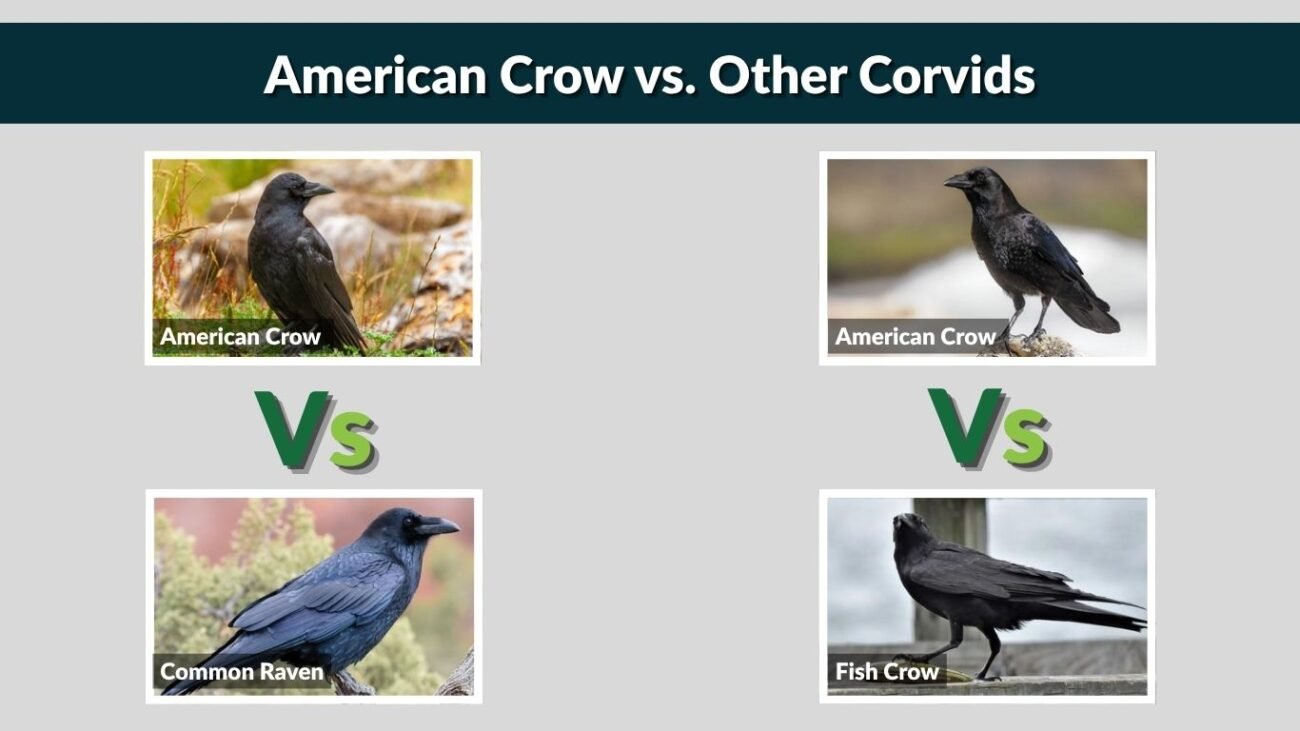
American Crow vs. Common Raven
At first glance, the Common Raven and American Crow appear similar, but several differences help identify them. Ravens are much larger, often the size of a hawk, and have wedge-shaped tails compared to the crow’s fan-shaped tail. Crows emit a sharp “caw,” while ravens produce a deeper, croaking “gronk” sound. Behaviorally, crows are more social and often seen in groups, whereas ravens are usually solitary or travel in pairs.
American Crow vs. Fish Crow
The Fish Crow, native to the southeastern United States, is smaller and more slender than the American Crow. The easiest way to tell them apart is by sound — Fish Crows make a nasal “uh-uh” call, distinct from the American Crow’s loud “caw.” While their habitats sometimes overlap, Fish Crows prefer coastal areas and wetlands, whereas American Crows inhabit a broader range of environments.
Cultural and Symbolic Significance
The Crow in Native American Culture
In Native American traditions, the crow holds powerful symbolic meaning. Many tribes regard the crow as a messenger between the physical and spiritual worlds. The Crow Tribe, native to the Northern Plains, views the bird as a sacred protector and symbol of wisdom. For other tribes, crows represent transformation, foresight, and knowledge. They are often featured in myths and folklore as tricksters or guides who teach humans about balance and survival. Their black color, intelligence, and mysterious behavior have made them central figures in storytelling and ceremonies for centuries.
Symbolism and Meaning
Across cultures, the crow symbolizes intelligence, adaptability, and rebirth. In some interpretations, seeing a crow can signify change or a spiritual awakening. While Western myths often associate crows with death or misfortune, Native American perspectives emphasize renewal and communication with ancestors. This dual symbolism reflects humanity’s complex relationship with the bird — one of awe, fear, and deep respect.
Artistic and Modern Representations

Tattoos and Art Styles
The American Crow is a popular subject in tattoo art, especially within the American Traditional style. These tattoos often depict the crow with bold outlines and symbolic imagery such as skulls, moons, or keys. In tattoo symbolism, the crow represents transformation, intelligence, and freedom. For some, it also serves as a reminder of intuition and adaptability — qualities the bird embodies naturally.
Crows in Literature and Media
Throughout history, crows have appeared in literature, paintings, and film as mysterious yet wise figures. In John James Audubon’s famous plate illustrations, the American Crow is portrayed in striking detail, emphasizing its grace and dark beauty. In modern media, the crow often symbolizes intelligence or the blurred line between life and death, echoing its ancient mythological roots. Even pop culture references, such as Russell Crowe’s roles in American films, play subtly on the name’s resonance with strength and mystery.
Fun Facts and Lesser-Known Details
- American Crows can mimic human voices and other sounds, similar to parrots.
- They recognize individual human faces — and remember those who threaten them.
- Crows use traffic lights to time food retrieval on roads.
- Groups of crows are called a “murder”, reflecting old folklore associations.
- They perform funeral-like gatherings, where crows surround a fallen companion in apparent mourning or observation.
Key Takeaways
- The American Crow (Corvus brachyrhynchos) is one of North America’s most intelligent birds.
- It thrives in both urban and natural environments due to its adaptability.
- Known for complex communication and problem-solving abilities.
- Plays a key role in ecosystems as scavengers and pest controllers.
- Deeply symbolic in Native American culture, representing wisdom and transformation.
FAQs
What is the scientific name of the American Crow?
The scientific name of the American Crow is Corvus brachyrhynchos, meaning “short-billed crow.” It belongs to the Corvidae family, which includes ravens, magpies, and jays — all known for their intelligence and adaptability.
How can you tell an American Crow from a raven?
Crows are smaller, with fan-shaped tails and higher-pitched “caw” calls. Ravens are larger, have wedge-shaped tails, and produce deeper, croaking sounds. Crows are also more social, while ravens are typically solitary.
What does the American Crow eat?
Crows are omnivorous and eat insects, fruits, seeds, carrion, and even human leftovers. Their diet varies depending on season and location, showcasing their incredible adaptability to different environments.
What does a crow symbolize in Native American culture?
For many Native American tribes, crows symbolize transformation, wisdom, and the balance between life and spirit. They are considered messengers and teachers, guiding humans through change and self-discovery.
How long do American Crows live in the wild?
In the wild, American Crows live about 7 to 8 years on average, though some reach 15 years or more. With fewer threats in captivity, their lifespan can extend beyond 20 years.


