











Distinguishing male vs female turkeys can be surprisingly challenging—especially when observing wild turkeys from a distance or identifying young turkey poults. Whether you are a hunter, farmer, wildlife observer, or simply curious, knowing how to tell male turkeys vs female turkeys apart helps you understand their behavior, breeding patterns, and physical traits. This guide covers wild turkeys, domestic breeds, heritage turkeys, turkey vultures, turkey tracks, turkey poop differences, and chick identification—all in one place.
Understanding Turkey Terminology

Before diving in, here are the common terms used for turkeys:
- Male turkey = Tom or Gobbler
- Female turkey = Hen
- Young male = Jake
- Young female = Jenny
- Baby turkeys = Poults
- Juveniles (mixed) = Turkey chicks
Key Differences Between Male and Female Turkeys

If you want a fast way to spot the difference between a female vs male turkey, here are the most reliable traits:
1. Size
- Males are much larger, heavier, and bulkier.
- Females are smaller, lighter, and slimmer.
2. Feather Color
- Male feathers are iridescent—bronze, copper, green, and gold.
- Female feathers are dull brown, offering camouflage.
3. Head Features
- Males have bright blue and red heads with a large snood and wattle.
- Females have smaller, lighter-colored heads with less pronounced features.
4. Tail Fan
- Males display a full, rounded fan when strutting.
- Females rarely fan their tail, and if they do, it looks uneven.
5. Beard
- Most males have a beard—a tuft of long hair-like feathers on the chest.
- Only 5–10% of females grow beards, usually short and thin.
6. Sounds
- Males gobble.
- Females yelp, cluck, and purr.
These differences apply across most species: wild turkey male vs female, domestic turkey male vs female, and heritage breeds.
Physical Differences Explained in Detail
1. Body Size & Shape
One of the clearest ways to distinguish male vs female turkeys is overall size.
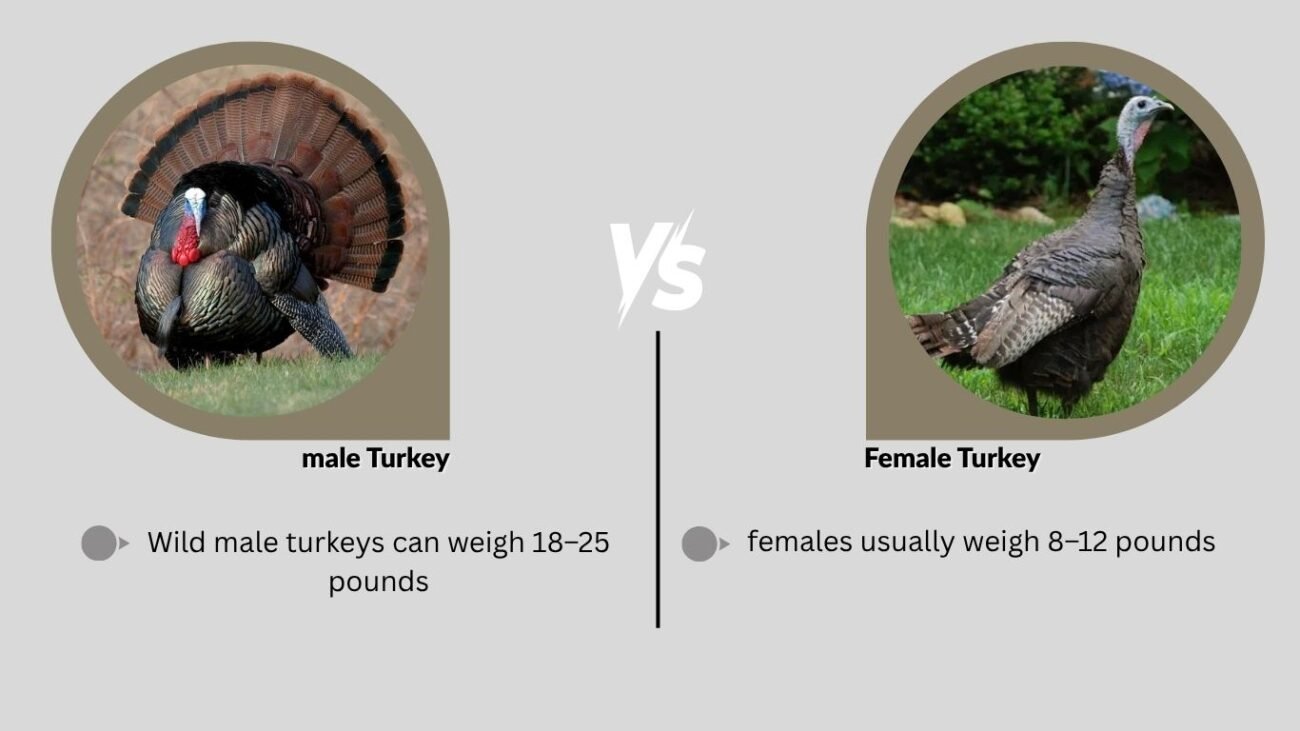
Wild male turkeys can weigh 18–25 pounds, while females usually weigh 8–12 pounds. The difference is noticeable in both Eastern wild turkey male vs female and Rio Grande turkey male vs female.
Domestic meat breeds such as the Broad Breasted White turkey male vs female show an even larger size gap. Males grow extremely fast and are bred for massive breast muscles, whereas females remain smaller and lighter.
2. Feather & Plumage Differences
Feather coloration is one of the easiest visual indicators.
Male Turkeys (Toms)
- Iridescent feathers that shine bronze, green, red, gold
- Large, glossy tail fan
- More prominent wing bars
- Strong chest feather contrast
Female Turkeys (Hens)
- Muted brown and gray feathers
- More uniform color
- Designed for camouflage when nesting
This difference appears in all breeds, including:
- Royal Palm turkey male vs female
- Blue Slate turkey male vs female
- Broad Breasted Bronze turkey male vs female
- White turkey male vs female
3. Head, Snood & Wattle
The head region is where the male vs female turkey distinction is most dramatic.
Male Turkey Head
- Bright red, blue, and white
- Long snood (the fleshy nose extension)
- Enlarged wattle
- Thick caruncles
- Turns more colorful during mating season
Female Turkey Head
- Small snood
- Light blue-gray head
- Less colorful
- Smaller caruncles
This also helps identify wild turkey female vs male even at a distance.
Tail Fan Differences
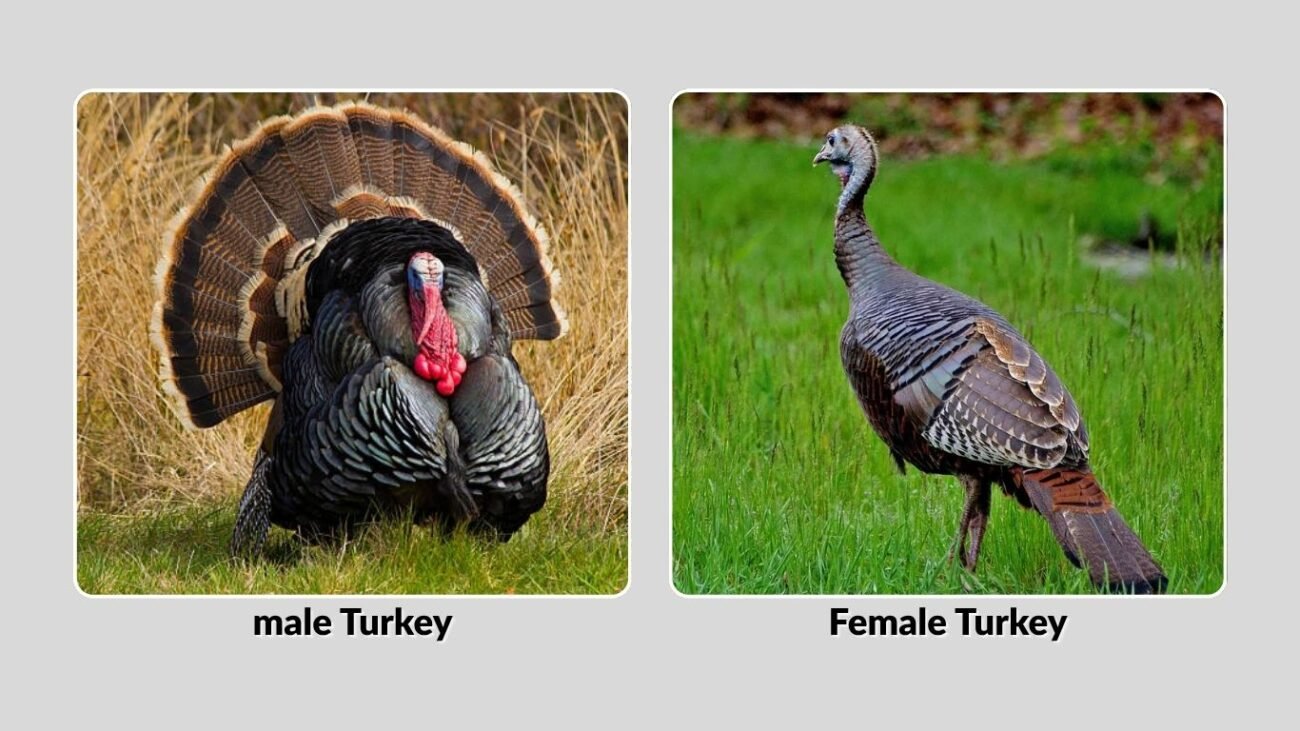
Male turkeys are famous for their impressive tail fan displays. When a tom struts, he spreads his tail feathers into a large, rounded fan—perfectly even and symmetrical. This display is a major part of courtship and territorial behavior. Female turkeys rarely fan their tails, and even when they do, the fan usually looks uneven or incomplete. In wild turkeys such as Eastern, Rio Grande, Merriam’s, and Osceola, the shape and color contrast of a male’s tail band are extremely pronounced. Hens, on the other hand, have more muted tail markings, making them blend into forest vegetation when they nest. Observers often use tail fan symmetry as the fastest way to distinguish a male wild turkey vs female in spring.
Behavior Differences
Behavior is another reliable way to separate a male vs female turkey. Male turkeys are noticeably more aggressive, territorial, and vocal. They perform elaborate strutting rituals—puffing out feathers, dragging wing tips, fanning tails, and gobbling loudly to attract mates. Females behave very differently. They travel in small family groups and focus on foraging quietly while keeping alert for predators. During nesting season, hens seek secluded areas, often near bushes or tall grass, and spend long periods sitting on their eggs. Males rarely participate in raising young, choosing instead to remain with bachelor groups. These behavioral contrasts help hunters and wildlife watchers identify wild turkey male vs female even when visibility is low.
Section With List Items: Tracks & Poop Differences
A. Turkey Tracks: Male vs Female
- Males have larger, wider tracks due to heavier weight.
- Males show a more pronounced middle toe impression.
- Females leave smaller, narrower tracks that appear lighter.
- Strut marks—wing-tip drag lines—indicate a male has been strutting.
B. Turkey Poop: Male vs Female
- Male turkey poop is typically J- or L-shaped.
- Female turkey poop is more spiral or clumped.
- Poop size is usually larger in males due to their bigger bodies.
- Water content is higher in hens during egg-laying periods.
Breed-Specific Male vs Female Differences

Domestic turkey breeds display many of the same differences as wild turkeys, but selective breeding has exaggerated certain traits. For example, the Broad Breasted White male vs female comparison shows an enormous size gap. Males are so heavy that they often cannot mate naturally and must be bred artificially, while females remain lighter and more active. Heritage breeds like Royal Palm, Blue Slate, Bronze, and Ocellated turkeys show more natural male–female variations. In the Bronze and Slate breeds, toms maintain bright iridescent feathers while hens remain muted. In white breeds, head features, snood length, and body mass become the primary indicators because feathers do not provide the same contrast. Regardless of breed, male turkeys almost always maintain stronger head coloration, longer beards, and larger size.
Identifying Male vs Female Turkey Chicks & Juveniles
Determining the sex of turkey poults is challenging because most adult traits—beard, snood length, wattle size, and coloration—are not fully developed. However, subtle differences appear early. Male poults tend to grow slightly faster, developing thicker legs and more prominent leg scales by a few weeks old. As they mature into juveniles, young males (jakes) begin to show early beard growth, even if only a small tuft. Their snoods also start responding to excitement and may droop forward. Juvenile hens (jennies) keep shorter snoods and consistently lighter feathering without the shiny sheen seen in jakes. Behavior also provides clues, as young males begin trying to strut early, while females rarely show this behavior.
Turkey Vultures: Male vs Female
Surprisingly, turkey vultures male vs female are almost identical. Unlike wild turkeys, turkey vultures show very little sexual dimorphism. Both sexes share the same feather coloration, bald red heads, and wingspan features. Size differences exist but are extremely subtle. The only reliable indicator is often behavior or measured weight during banding. Because their appearance is nearly identical, observers cannot distinguish male turkey vultures vs female by sight alone.
Meat, Taste, and Thanksgiving Differences
People often wonder whether a male vs female turkey tastes better for Thanksgiving. Male turkeys grow larger and have more breast meat, making them popular for commercial production. Females tend to have slightly more tender flesh, especially in heritage breeds. Flavor differences are mild, and most consumers cannot distinguish them. For holiday meals, size preference usually determines choice rather than taste.
Common Misidentifications
Many beginners confuse large female turkeys with small males or juvenile jakes with hens. Beard length, head coloration, and snood size are the most reliable clues. Another common mistake is assuming white domestic turkeys show no male–female differences. Even in white breeds, snood length and body mass remain clear indicators.
FAQs
1. What is the easiest way to tell a male vs female turkey apart?
The quickest method is to look at the head and snood. Male turkeys (toms) have bright, colorful, enlarged fleshy features—especially the snood, wattle, and caruncles—which turn vibrant red, blue, or white. Females (hens) have shorter snoods, duller heads, and smaller wattles that remain mostly pink. Size and behavior, such as strutting and gobbling, also provide reliable clues.
2. Do female turkeys ever grow beards like males?
Yes, but it’s rare. About 5–10% of female turkeys develop beards. When hens grow beards, they are typically thinner, shorter, and more brittle than male beards. Because female beards are uncommon, beard length is still considered a strong indicator that a turkey is male.
3. Are male or female turkeys better for eating?
It depends on the preference and the breed. Male turkeys grow larger, making them ideal when a big bird is needed for holidays like Thanksgiving. Females are generally more tender, especially among heritage breeds. Flavor differences are small, and most consumers cannot distinguish between male and female meat unless they are comparing heritage birds.
4. Why do male turkeys gobble but females do not?
Gobbling is a courtship and dominance call used exclusively by males. It’s designed to attract females during mating season and warn other males of their presence. Females communicate through softer sounds—yelps, clucks, and purrs—because they rely heavily on stealth for nesting and protecting poults.
5. Can you tell the difference between male vs female turkey poop?
Yes. Male turkey poop is typically J-shaped or L-shaped, forming a long, cylindrical dropping. Female turkey poop is usually spiraled or clumped, appearing more rounded. Hunters and wildlife trackers often use droppings and track patterns to determine whether males or females are nearby.


