Hummingbirds are among the most captivating birds on Earth, known for their vibrant colors, rapid wingbeats, and dazzling aerial displays. From the fiery-throated glow of tropical species to the icy resilience of high-altitude mountain dwellers, each hummingbird tells its own visual and ecological story. In this guide, you’ll discover 35 unique types of hummingbirds found across the Americas—each one with its own striking appearance, behavior, and habitat preference.
1. Ruby-throated Hummingbird

The Ruby-throated Hummingbird is the most widespread hummingbird species in eastern North America. Known for its dazzling throat and rapid wingbeats, this tiny bird is a symbol of summer gardens and one of the few hummingbirds that migrate across the Gulf of Mexico.
Identification
- Small size (about 3–3.5 inches long)
- Males have a brilliant, iridescent ruby-red throat
- Both sexes have metallic green backs and pale undersides
- Long, slender, slightly curved black bill
- Rapid wingbeats that produce a faint hum
Habitat
Ruby-throated Hummingbirds prefer open woodlands, gardens, meadows, and suburban areas with flowering plants. They are common visitors to backyard feeders, especially those filled with sugar water during migration and summer.
Behavior
These hummingbirds are fast, agile flyers, capable of hovering and flying backward. Males are territorial, often seen chasing away intruders near feeders or flower patches. They migrate long distances between Central America and North America, with some flying nonstop across the Gulf of Mexico.
Color Pattern
Males display a vivid ruby-red throat that may appear dark in low light but flashes brilliantly in the sun. Females lack the red throat and have more subdued white underparts. Both sexes have shimmering green upperparts that reflect light beautifully.
2. Anna’s Hummingbird

Anna’s Hummingbird is a year-round resident along the Pacific Coast of North America. Known for its brilliant pinkish-red crown and throat, it is one of the most vocal and resilient hummingbird species, even active during winter months.
Identification
- Medium-sized hummingbird (about 3.9 inches long)
- Males have an iridescent rose-pink crown and throat
- Females have a grayish throat with tiny red spots
- Green back and pale gray belly
- Straight, slender black bill
Habitat
Common in coastal scrub, gardens, parks, and open woodlands. Anna’s Hummingbirds thrive in urban areas, often nesting in backyard trees or shrubs.
Behavior
Unlike most hummingbirds, Anna’s sing a series of scratchy, metallic notes during courtship. Males perform dramatic display dives, producing sharp sounds with their tail feathers. They are bold, curious, and often visit feeders year-round.
Color Pattern
Males shine with metallic green backs and rose-pink heads and throats, which can appear dull or black until light strikes just right. Females are greenish above and grayish below, with subtle reddish spotting.
3. Black-chinned Hummingbird

The Black-chinned Hummingbird is a widespread species in the western U.S., recognized by its dark throat and adaptability to both wild and urban environments. It’s known for its buzzing courtship dives and slender build.
Identification
- Small size (about 3.5 inches long)
- Males have a black throat with a narrow, iridescent purple band at the base
- Females have a plain throat with fine spotting
- Greenish back and pale underparts
- Long, straight, thin bill
Habitat
Found in deserts, canyons, riversides, and urban gardens throughout the western United States. They nest in sheltered shrubs and trees, often near water.
Behavior
Black-chinned Hummingbirds are territorial during breeding and frequently visit nectar feeders. Males perform J-shaped courtship flights with sharp, whistling wing sounds. They are known for their quiet nature compared to other hummingbirds.
Color Pattern
Males appear black-throated in low light, but flash a violet stripe when viewed in sunlight. Females and juveniles are more subdued, with white underparts and green backs.
4. Rufous Hummingbird
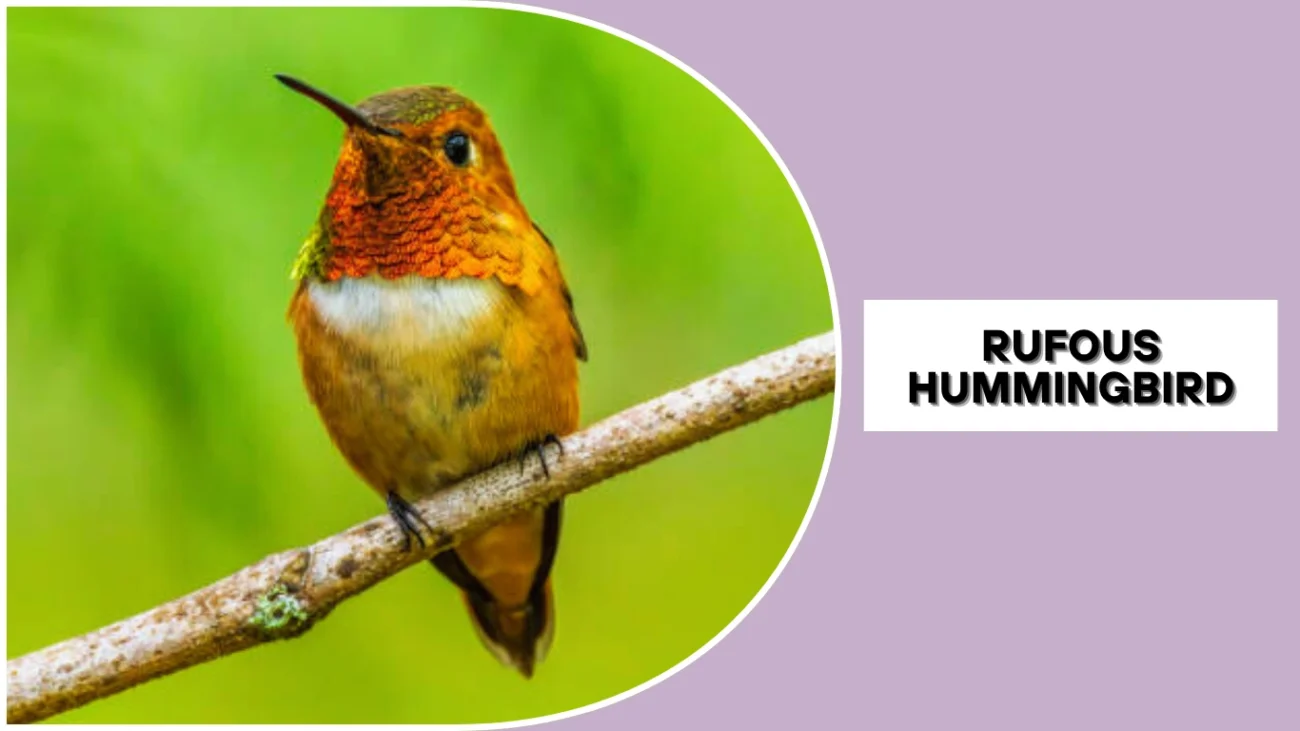
The Rufous Hummingbird is famous for its fiery orange coloring and aggressive nature. Despite its tiny size, it is highly territorial and fiercely defends feeding areas. This species makes one of the longest migratory journeys of any hummingbird in North America.
Identification
- Small size (about 3 inches long)
- Males are bright orange with a vivid iridescent red throat
- Females are greenish above with rusty flanks and a spotted throat
- Short wings and a straight black bill
- Tail often appears rufous in flight
Habitat
Breeds in open woodlands and mountain meadows of the Pacific Northwest and Alaska. Migrates through deserts, coastal gardens, and forest edges en route to Mexico for winter.
Behavior
Rufous Hummingbirds are extremely bold and territorial, often chasing away much larger birds from feeders or flower patches. They’re fast flyers and frequently return to the same feeding sites each year during migration.
Color Pattern
Males have a glowing orange back and belly with a shimmering red-orange throat. Females and juveniles show a mix of green and rusty tones, making them easy to identify when compared to other hummingbirds.
5. Allen’s Hummingbird

Allen’s Hummingbird closely resembles the Rufous but is slightly smaller and more restricted in range. It is found mostly along the coastal regions of California and is known for its rapid wingbeats and dazzling courtship dives.
Identification
- Small size (about 3–3.5 inches long)
- Males have a bright orange body with a metallic reddish-orange throat
- Females are greenish above with rusty flanks and a pale belly
- Slightly curved black bill and short tail
Habitat
Prefers coastal brushlands, gardens, and chaparral habitats of California. During migration, it may be seen in lowland fields and city parks.
Behavior
Males perform dramatic U-shaped dives during courtship, producing mechanical trills with their tail feathers. Like the Rufous, they are aggressive and territorial, especially around feeders and flowering plants.
Color Pattern
Males are brilliant orange with a glowing throat, while females display a softer mix of green, white, and rusty tones. Though similar to Rufous Hummingbirds, Allen’s tend to have narrower outer tail feathers and more limited breeding ranges.
6. Broad-tailed Hummingbird

The Broad-tailed Hummingbird is a high-elevation specialist, commonly found in mountainous regions of the western United States. Its distinctive trilling wing sound in flight and shimmering throat make it easy to recognize in alpine meadows and woodlands.
Identification
- Medium size (about 4 inches long)
- Males have a brilliant rose-magenta throat (gorget)
- Females are green above with pale underparts and buffy flanks
- Broad tail with rounded tips
- Long, straight black bill
Habitat
Inhabits mountain meadows, pine forests, and open woodlands at elevations above 6,000 feet. Breeds in the Rockies and surrounding ranges, migrating to Mexico and Central America for winter.
Behavior
Males produce a distinct, high-pitched trilling sound with their wings during flight, especially in courtship displays. They hover at flowers and feeders and are moderately territorial. Females build nests low in conifer trees or shrubs.
Color Pattern
Males show iridescent green backs and pinkish-red throats that gleam in sunlight. Females are less colorful but have a subtle green sheen on the back and buff-colored sides.
7. Costa’s Hummingbird

Costa’s Hummingbird is a desert-dwelling species known for its stunning violet-purple throat and crown. It thrives in arid habitats and is one of the few hummingbirds that breed in the southwestern deserts of the U.S.
Identification
- Small size (about 3–3.5 inches long)
- Males have a deep violet-purple gorget and crown that flare outward
- Females are pale below with greenish upperparts and a plain face
- Short tail and compact frame
Habitat
Found in desert scrub, chaparral, cactus stands, and arid coastal regions of California, Arizona, and Baja California. Frequently visits desert flowers and feeders in residential areas.
Behavior
Males perform spectacular courtship dives, accompanied by a high-pitched screech created by their wings. They are aggressive defenders of feeding territories and nest early in the season—often before spring fully arrives.
Color Pattern
Males are metallic green above with rich violet-purple on the crown and throat that glows in direct light. Females are more muted, with grayish-white undersides and a lightly speckled throat.
8. Calliope Hummingbird

The Calliope Hummingbird is the smallest breeding bird in North America. Despite its tiny size, it’s a tough and long-distance migrant, traveling thousands of miles between Canada and Mexico each year.
Identification
- Very small (about 3 inches long)
- Males have a striking magenta-purple gorget with streaked lines that flare outward
- Females are green above with pale underparts and faint streaks on the throat
- Short tail and straight, thin black bill
Habitat
Breeds in mountainous meadows and forest edges across the northwestern U.S. and southern Canada. During migration, it travels through deserts, valleys, and foothills, wintering in Mexico.
Behavior
Calliope Hummingbirds are feisty and bold, often defending feeders and flowers from larger species. Males perform shuttle-display flights during courtship, buzzing back and forth in front of females.
Color Pattern
Males show iridescent magenta throat feathers arranged in bold vertical lines. Their upperparts are metallic green, while the underparts are white or light buff. Females and juveniles lack the bright gorget and appear more subdued.
9. Buff-bellied Hummingbird

The Buff-bellied Hummingbird is a large, brightly colored hummingbird found mainly in the Gulf Coast region and parts of Central America. It is known for its energetic behavior and rich color palette.
Identification
- Medium to large size (about 4–4.5 inches long)
- Metallic green body with a buff or cinnamon-colored belly
- Reddish bill with a black tip (especially in males)
- Slightly curved wings and long tail
Habitat
Found in subtropical woodlands, thorn scrub, and gardens from southern Texas to the Yucatán Peninsula. Frequently visits backyard feeders and flowering plants near the coast.
Behavior
Buff-bellied Hummingbirds are bold and active, often chasing away other hummingbirds from feeders. They are strong flyers and may expand their range northward during warmer months.
Color Pattern
They have a vibrant green upper body, cinnamon or buff-colored belly, and a striking reddish bill. In bright light, their plumage shines with metallic tones, making them stand out among other hummingbird species.
10. Blue-throated Mountain-gem
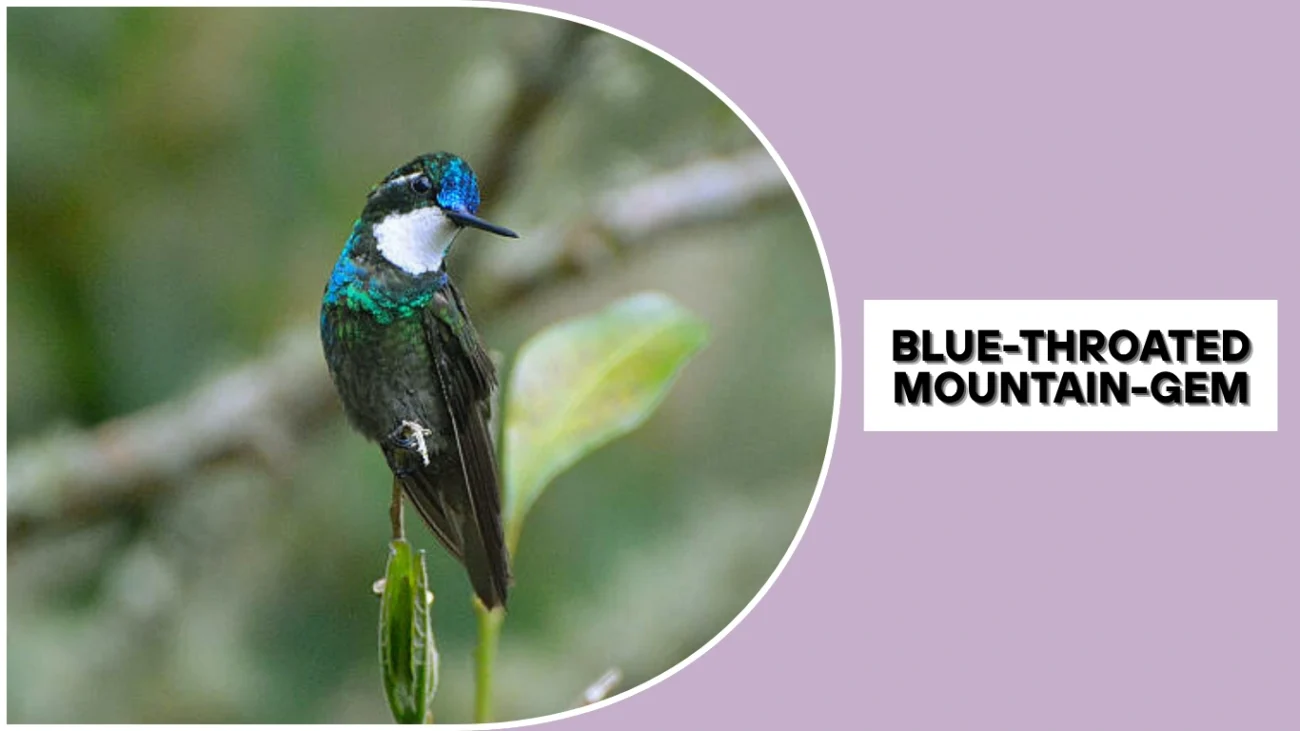
The Blue-throated Mountain-gem is the largest hummingbird species regularly found in the United States. Native to mountainous regions of the Southwest, it’s known for its deep blue throat and loud, sharp calls.
Identification
- Large size (about 4.5–5.1 inches long)
- Males have an iridescent sapphire-blue throat
- Both sexes have grayish underparts and greenish upperparts
- Bold white stripe behind the eye
- Thick, slightly curved black bill
Habitat
Inhabits shady canyons, pine-oak forests, and mountain stream edges in Arizona, New Mexico, and northern Mexico. Often seen near flowers or feeders in cooler, forested elevations.
Behavior
These hummingbirds are assertive and vocal. Males perch high to guard territories and emit loud chip calls. They also hover at feeders and are known to flick their tails when alert or agitated.
Color Pattern
Males have a striking metallic blue throat that contrasts with their pale gray chest and belly. Females lack the blue but retain the eye stripe and soft green coloring.
11. Magnificent Hummingbird (also known as Rivoli’s Hummingbird)

The Magnificent Hummingbird is a dazzling and relatively large species with a brilliant, shimmering plumage. Found mostly in mountainous areas of the Southwest and Central America, it’s admired for its size and radiant colors.
Identification
- Large size (about 5.1 inches long)
- Males have a metallic green body, bright violet crown, and glittering emerald throat
- Females are green above with dull gray underparts
- Dark tail with white tips
- Long, straight black bill
Habitat
Lives in highland forests, pine-oak woodlands, and mountainous ravines in Arizona, New Mexico, and southward into Central America.
Behavior
Magnificent Hummingbirds are powerful and deliberate in flight. They often dominate feeders and chase off smaller species. Males perform diving and buzzing displays during courtship.
Color Pattern
Males shimmer with jewel-toned green, blue, and purple feathers that change depending on the light. Females are more subdued, with a soft green back and grayish-white belly, but still exhibit a regal posture.
12. Lucifer Hummingbird

The Lucifer Hummingbird is a desert specialist, found primarily in arid canyons and flowering desert slopes. Known for its unique curved bill and vibrant throat, it’s one of the most striking hummingbirds of the southwestern U.S. and northern Mexico.
Identification
- Small to medium size (about 3.5–4 inches long)
- Males have a vivid magenta-purple, deeply forked gorget
- Females are pale below with greenish backs and curved bills
- Long, decurved (downward-curving) black bill
- Long tail, deeply forked in males
Habitat
Found in desert canyons, thorn scrub, and agave-covered hillsides in southern Arizona, Texas, and northern Mexico. They favor areas with blooming desert plants like ocotillo and agave.
Behavior
Lucifer Hummingbirds are agile and prefer feeding at long tubular flowers. Males perform shuttle displays in front of females and frequently call from low perches. Their specialized bill is adapted for desert blossoms.
Color Pattern
Males flash an iridescent magenta throat and show metallic green upperparts. Females lack the brilliant gorget but share the long, curved bill and slender shape.
13. White-eared Hummingbird

The White-eared Hummingbird is a forest-dwelling species with a distinctive facial pattern and active, buzzing presence. It’s most commonly seen in pine-oak woodlands of Mexico but occasionally visits mountain habitats in the southwestern U.S.
Identification
- Small size (about 3.5–4 inches long)
- Both sexes have a bold white stripe behind the eye (the “white ear”)
- Males have a bright green body and a glittering turquoise-green throat
- Red bill with a black tip
- Females are duller with similar facial markings
Habitat
Prefers highland forests, especially pine, fir, and oak zones. Found in southern Arizona, New Mexico, and Mexico, often near forest clearings, flowering shrubs, and mountain lodges.
Behavior
White-eared Hummingbirds are fast and agile, often hovering low among shrubs and quickly darting between blooms. They are highly vocal and frequently visit feeders in high elevations.
Color Pattern
Males shimmer in emerald and turquoise tones with the signature white cheek stripe and a vivid red-and-black bill. Females are plainer but still easily recognizable by the white facial stripe and green back.
14. Violet-crowned Hummingbird

The Violet-crowned Hummingbird is a striking and elegant species, best known for its snow-white belly and brilliant violet-blue crown. Though limited in range, it’s a favorite among birders in the southwestern U.S. and Mexico.
Identification
- Medium size (about 4–4.5 inches long)
- Males and females look similar
- Bright violet-blue crown
- Snow-white underparts and green back
- Straight red bill with a black tip
Habitat
Found in riparian woodlands, desert canyons, and montane forest edges in southeastern Arizona and western Mexico. Often visits feeders and flowering trees near water sources.
Behavior
This species is quiet and composed, often hovering with slow, controlled movements. It’s less aggressive than other hummingbirds but will still defend feeding areas when needed. Nests are typically built on horizontal tree branches.
Color Pattern
Clean white underparts contrast beautifully with the dark green back and shimmering violet crown. The red bill adds a splash of color, making it one of the most easily recognized hummingbirds in its range.
15. Berylline Hummingbird

The Berylline Hummingbird is a rare but increasingly observed visitor in the southwestern U.S., especially southern Arizona. Its glowing green and copper colors make it a vivid jewel in forested mountain regions.
Identification
- Medium size (about 4 inches long)
- Both sexes have bright metallic green heads and chests
- Reddish-bronze wings and lower back
- Slightly curved black bill
- Males are more vibrant, but females look similar
Habitat
Prefers pine-oak forests, canyons, and scrubby woodlands at mid-to-high elevations. Found mostly in Mexico, with a few crossing into southeastern Arizona each year.
Behavior
Berylline Hummingbirds are confident and active, frequently visiting feeders and native flowers. Males can be territorial, often perching conspicuously to guard food sources.
Color Pattern
These hummingbirds display glowing green bodies with rich rufous or bronze wings and rump. The combination of green and copper gives them a warm, burnished appearance in sunlight.
16. Green-breasted Mango

The Green-breasted Mango is a bold, tropical hummingbird known for its sleek body and rich emerald coloring. Found mostly in Central America, it occasionally reaches the southern U.S., particularly southern Texas and the Gulf Coast.
Identification
- Medium to large size (about 4.5–5 inches long)
- Males have a metallic green body with a dark blue-black throat stripe extending down the chest
- Females have a white underside with a bold dark stripe from chin to belly
- Slightly decurved black bill
Habitat
Prefers tropical forests, coastal lowlands, and plantations. In the U.S., it visits hummingbird feeders and flowering gardens in southern Texas, especially during the summer and fall.
Behavior
The Green-breasted Mango is assertive and territorial, often chasing away other hummingbirds from feeding areas. It hovers skillfully and feeds from both feeders and long tubular flowers.
Color Pattern
Males display a glossy green body with a bluish-black stripe down the throat and chest. Females are less vivid but easily identifiable by the dark central stripe on a white belly.
17. Mexican Violetear

The Mexican Violetear is a vibrant, forest-dwelling hummingbird known for its shimmering green body and violet-blue patches on the cheeks. It’s common in the highlands of Central America and is an occasional vagrant in the southern U.S.
Identification
- Medium size (about 4–4.5 inches long)
- Brilliant green body
- Iridescent violet ear patch on both sides of the head
- Slightly curved black bill
- Tail is square with a bluish sheen
Habitat
Found in subtropical forests, clearings, and woodland edges, especially at elevations above 4,000 feet. Occasionally visits feeders in Texas and along the Gulf Coast during dispersal events.
Behavior
Mexican Violetears are solitary and often perch quietly between feeding bouts. They can be aggressive at feeders and use high-pitched metallic calls to communicate and defend territory.
Color Pattern
This species shines with emerald-green plumage and deep violet cheek patches. In the right light, their colors appear electric, making them one of the most eye-catching hummingbirds in their range.
18. Broad-billed Hummingbird

The Broad-billed Hummingbird is a brilliant and energetic species found mainly in Mexico and the southwestern United States. Its vivid colors and bright red bill make it one of the most easily recognized hummingbirds in desert regions.
Identification
- Medium size (about 3.5–4 inches long)
- Males have a bright metallic green body and deep blue throat
- Females are duller with pale gray underparts and green backs
- Bright red bill with a black tip (both sexes)
- Short tail, slightly forked in males
Habitat
Favors desert canyons, riparian corridors, and scrubby habitats. Frequently seen in southeastern Arizona and southwestern New Mexico, especially near water and flowering plants.
Behavior
Active and territorial, Broad-billed Hummingbirds often visit feeders and chase off intruders. Males display by hovering in front of females and flashing their bright blue throats. They’re fast fliers and vocal, giving sharp “tik” or “chip” calls.
Color Pattern
Males shimmer with emerald green and deep sapphire-blue throats. The vivid red-and-black bill adds to their bold appearance. Females are less colorful but share the same bill pattern and overall shape.
19. Green-throated Carib
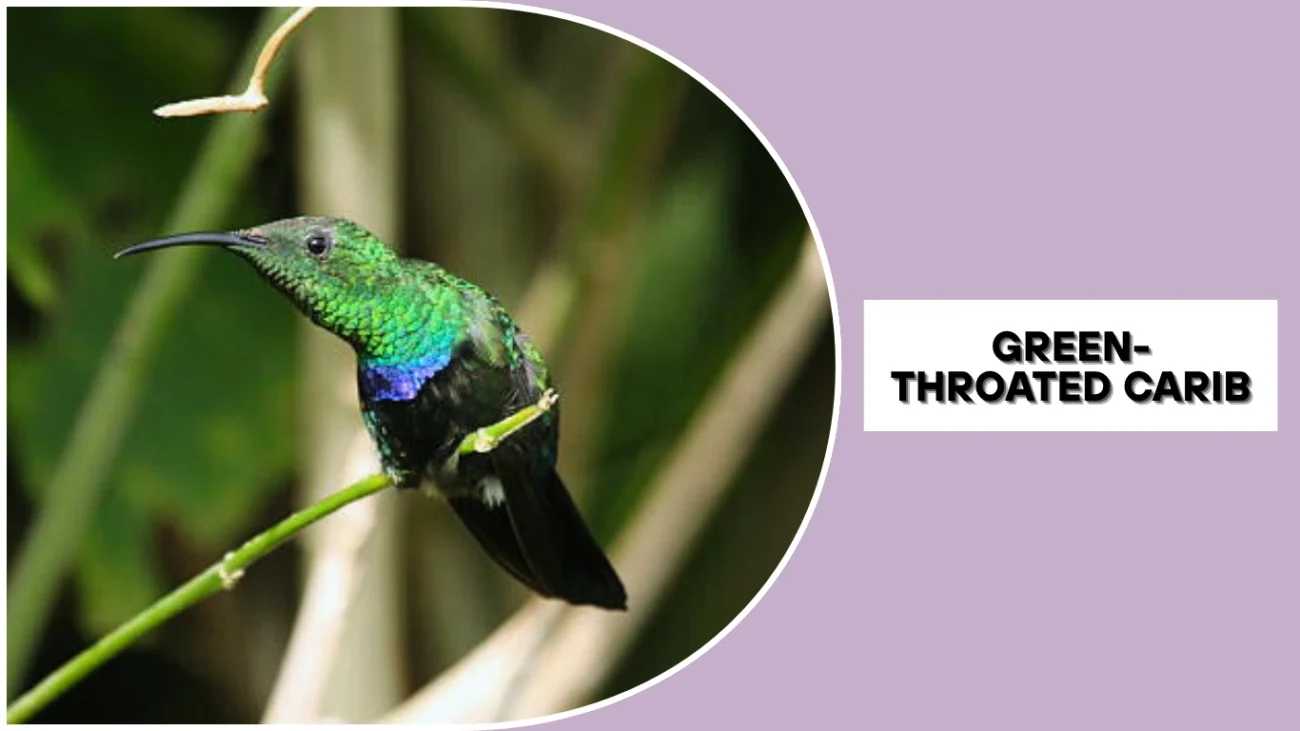
The Green-throated Carib is a large and striking hummingbird native to the Caribbean. It’s known for its vibrant iridescent plumage and strong, direct flight. While not found in the continental U.S., it’s common across many Caribbean islands.
Identification
- Large size (about 4.7–5 inches long)
- Males and females are similar in appearance
- Iridescent green throat and chest
- Deep blue-violet wings and rump
- Slightly decurved black bill
Habitat
Inhabits tropical forests, plantations, gardens, and coastal areas. Prefers shaded or semi-open areas where flowering trees and shrubs are abundant.
Behavior
Bold and dominant, Green-throated Caribs are aggressive at feeding sites and vocal in defense of their territories. They visit tubular flowers and feeders and are often seen perched openly.
Color Pattern
Brilliant green throats and chests contrast with violet-bluish wings and dark tails. Their shimmering coloration and confident flight style make them one of the most eye-catching hummingbirds in the Caribbean.
20. Antillean Crested Hummingbird

The Antillean Crested Hummingbird is a small and spunky species found in the Caribbean, particularly in the Lesser Antilles. It’s one of the few hummingbirds with a noticeable crest, giving it a unique and bold appearance.
Identification
- Small size (about 3–3.5 inches long)
- Males have a prominent spiky green crest and dark metallic green body
- Females are smaller, duller, and lack the crest
- Short, straight black bill
- Compact body and short tail
Habitat
Inhabits tropical lowland forests, gardens, plantations, and bushy coastal areas throughout the Lesser Antilles. Frequently visits flowering plants and feeders in both wild and human-influenced habitats.
Behavior
Highly energetic and territorial, males defend feeding areas with aerial chases and sharp calls. They are often seen darting between blossoms or perched near their favorite feeding spots.
Color Pattern
Males shine with metallic green from head to tail, highlighted by the upright crest that gives the species its name. Females are more subdued but still show a green back and pale underparts.
21. Purple-throated Carib
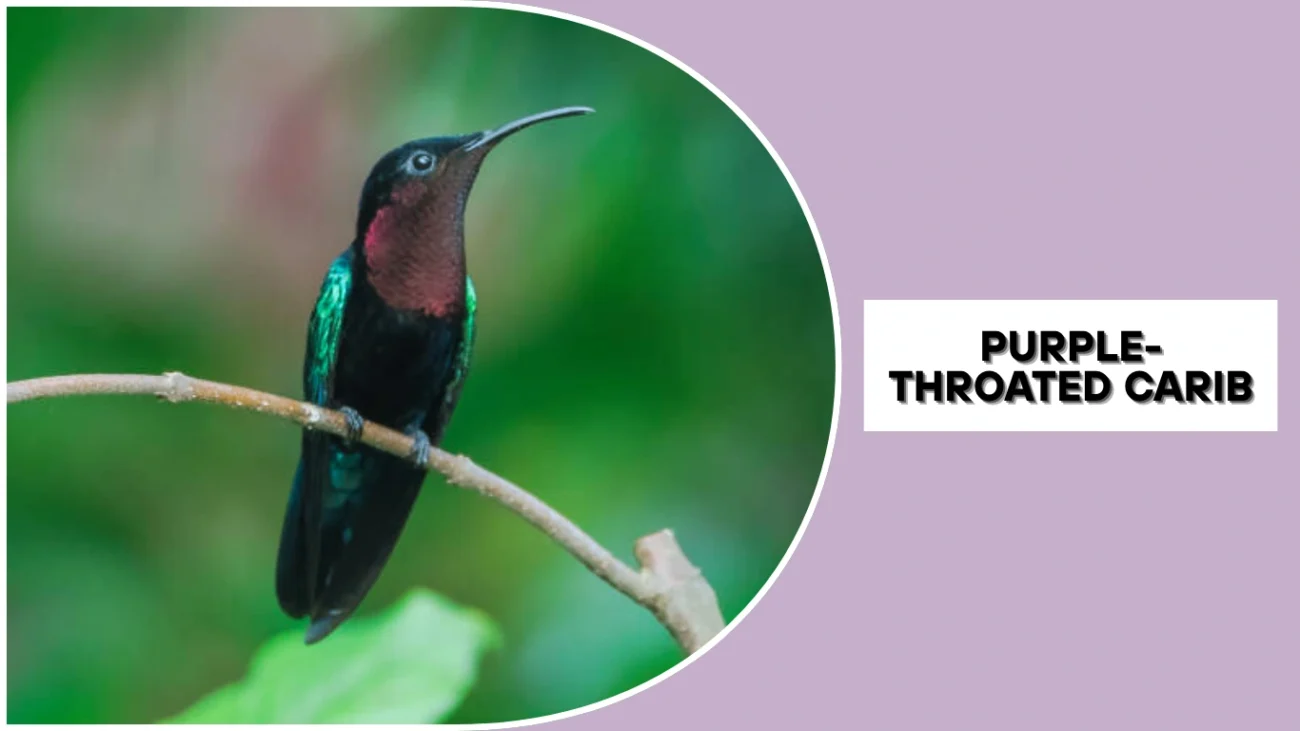
The Purple-throated Carib is a large, dazzling hummingbird native to the Caribbean, recognized for its colorful plumage and aggressive personality. It plays an important role as a pollinator in the tropical ecosystems of the islands.
Identification
- Large size (about 4.5–5 inches long)
- Males have a rich purple throat and breast with emerald green back
- Females are similar but slightly smaller and may vary in throat color
- Long, curved black bill
- Broad wings and robust body
Habitat
Common in rainforests, gardens, plantations, and mountain forests across the Lesser Antilles and parts of Puerto Rico. Found at various elevations, often following blooming cycles of specific plants.
Behavior
Extremely territorial and aggressive, especially at feeding sites. Males often dominate flowering shrubs, chasing away rivals and even other bird species. Their flight is fast, loud, and direct.
Color Pattern
Their purple throat flashes brilliantly in sunlight, contrasting with a velvety green back and dark blue wings. The combination of iridescent hues and commanding flight makes them one of the most vibrant birds in the region.
22. Long-billed Hermit
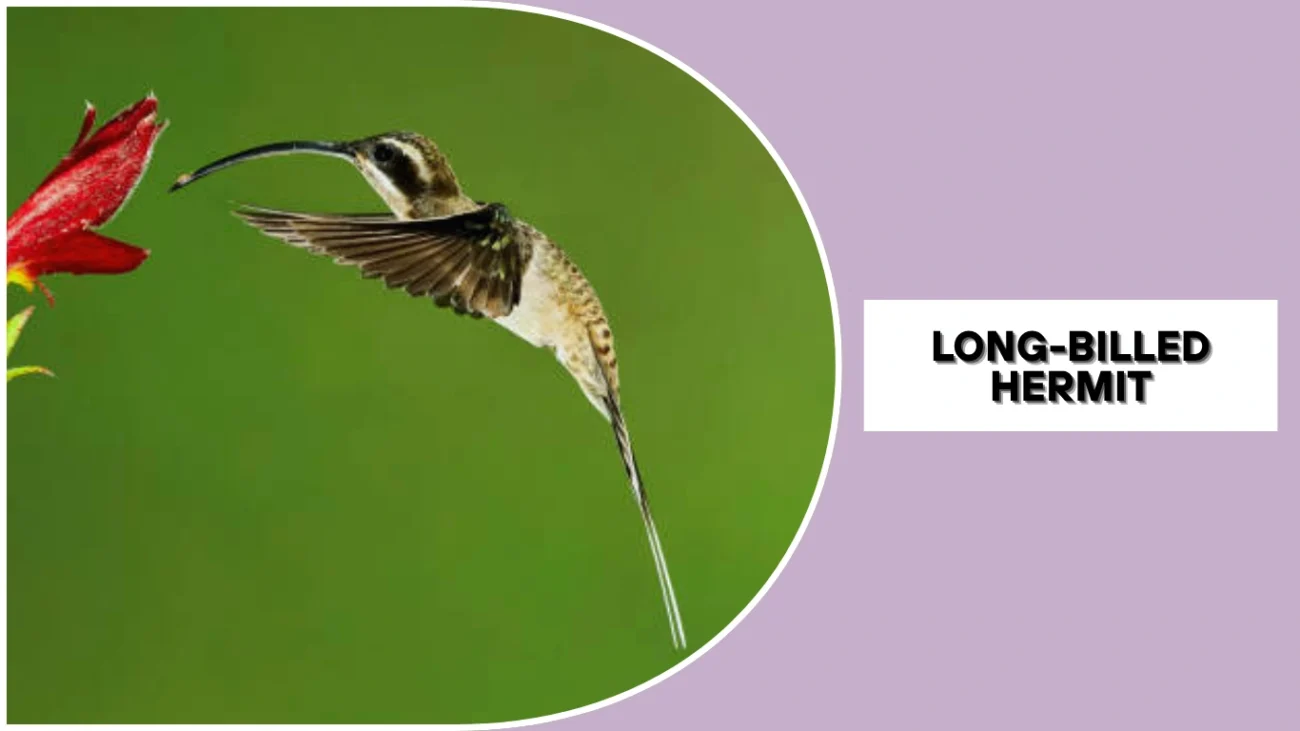
The Long-billed Hermit is a distinctive hummingbird found in the tropical lowlands of Central and South America. It is known for its long, curved bill and elegant tail streamers, adapted for feeding on deep tubular flowers.
Identification
- Medium to large size (about 5.5–6 inches long)
- Extremely long, decurved bill
- Brownish-olive body with a pale streak behind the eye
- Males have two long white-tipped tail streamers
- Dull metallic green or bronze upperparts
Habitat
Prefers humid lowland rainforests, forest edges, and shaded plantations. Common in Central America, from southern Mexico to western Colombia and Ecuador.
Behavior
Long-billed Hermits are “trapliners”—they follow a consistent route, visiting the same flowers in a circuit. Males gather at leks where they sing and display in front of females using vocalizations and tail flicks.
Color Pattern
They have a subdued color palette of browns, olive greens, and bronze tones, with long, distinct tail feathers that sway gracefully in flight. The long, curved bill helps them feed on flowers with deep corollas.
23. Little Hermit
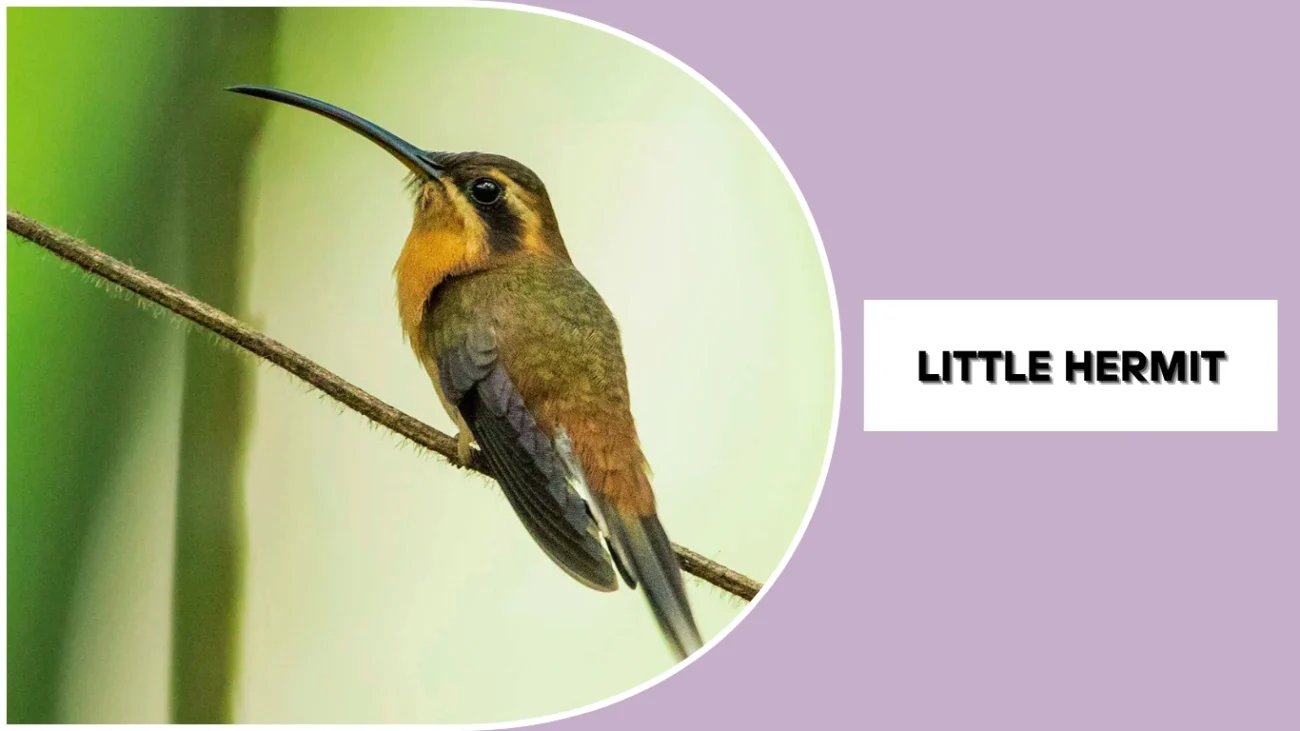
The Little Hermit is one of the smallest hummingbirds in the hermit group, often found flitting low through dense tropical forests. Despite its tiny size, it is swift, precise, and essential for pollination in the understory.
Identification
- Very small (about 3 inches long)
- Slender, curved black bill
- Brownish upperparts and orangish underparts
- Pale streak behind the eye
- Short, rounded wings and long tail streamers (in males)
Habitat
Lives in lowland rainforests, secondary growth, and shady plantations across northern South America and parts of Central America. Often stays close to dense foliage and forest interiors.
Behavior
Like other hermits, it practices traplining—feeding in a predictable circuit of flowering plants. It hovers low to the ground and is typically seen darting between thick vegetation.
Color Pattern
The plumage is earthy brown and cinnamon-orange with a pale facial stripe. Males have subtle but elegant white-tipped tail streamers that aid in identification during flight displays.
24. Stripe-throated Hermit
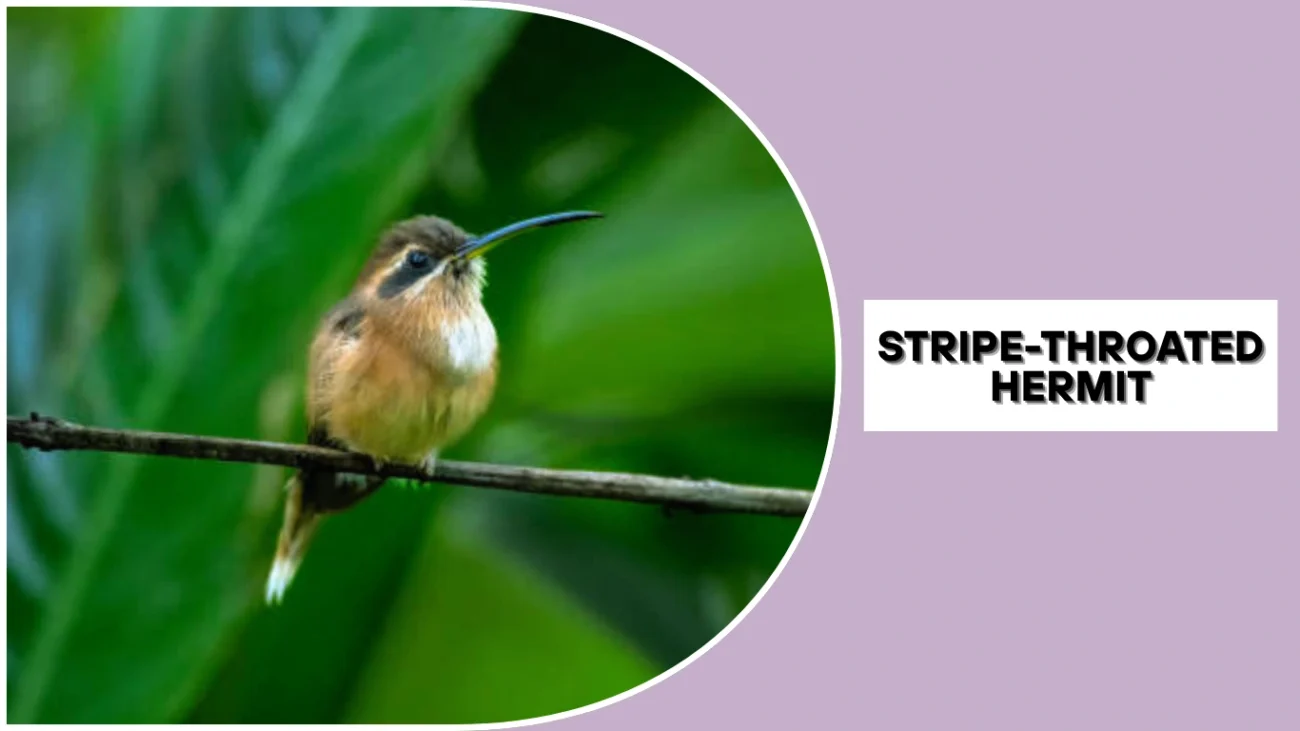
The Stripe-throated Hermit is a small, agile hummingbird commonly found in lowland tropical forests of Central and South America. Its name comes from the fine dark streaks on its throat, and like other hermits, it specializes in deep flowers and forest foraging.
Identification
- Small size (about 3.1–3.5 inches long)
- Curved black bill, slightly longer in males
- Brownish-olive upperparts
- Whitish to pale buff underparts with dark throat streaks
- Pale eye stripe and faint facial markings
Habitat
Inhabits wet lowland forests, edges, and secondary growth from southern Mexico through Central America to northern South America. Common in dense understory vegetation.
Behavior
This species is a classic trapliner, visiting a regular route of flowering plants. It moves swiftly through forest understory and is rarely seen at open feeders. Males may sing at leks and perform tail displays.
Color Pattern
Mostly dull brown and olive, with pale underparts and fine black streaking on the throat. The pale eye stripe and subtle face markings help differentiate it from other similar hermits.
25. Fiery-throated Hummingbird

The Fiery-throated Hummingbird is one of the most dazzling hummingbirds in the world, with a rainbow of iridescent colors that change with the light. Native to the highlands of Costa Rica and western Panama, it’s a favorite among bird photographers and enthusiasts.
Identification
- Medium size (about 4.3 inches long)
- Short, straight black bill
- Iridescent green body
- Brilliant throat with fiery shades of orange, red, yellow, and blue
- Dark wings and blue-black tail
Habitat
Found in cloud forests and high-elevation woodlands, typically between 6,000–11,000 feet. Often seen near flowering shrubs and feeders at mountain lodges or parks.
Behavior
These hummingbirds are aggressive and often dominate feeders and flower patches in their elevation range. They hover skillfully and engage in rapid chases with rivals.
Color Pattern
When sunlight hits their throat just right, it bursts into flaming rainbow hues—from deep blue to orange and gold. The rest of the body glows with emerald green, creating a truly unforgettable sight.
26. Violet Sabrewing

The Violet Sabrewing is one of the largest and most spectacular hummingbirds in Central America. Known for its bold violet coloring and broad wings, it is a powerful flyer and a striking presence in tropical forests.
Identification
- Very large size (about 5.5–6.3 inches long)
- Males are deep violet with dark green upperparts and blackish wings
- Females are green above with whitish underparts and violet speckling on the throat
- Thick, slightly decurved black bill
- Long, broad wings and tail
Habitat
Found in humid forests, cloud forests, and plantations from southern Mexico to Panama, typically between 3,000–7,000 feet elevation.
Behavior
Violet Sabrewings are dominant and territorial, frequently chasing off other hummingbirds. They visit a wide range of flowers and feeders and are capable of strong, direct flight. Males often sing from perches near flower patches.
Color Pattern
Males shine with velvety violet plumage on the body and throat, contrasted by metallic green on the back. Females are more muted, with a striking green-and-white contrast and hints of violet on the neck.
27. White-necked Jacobin
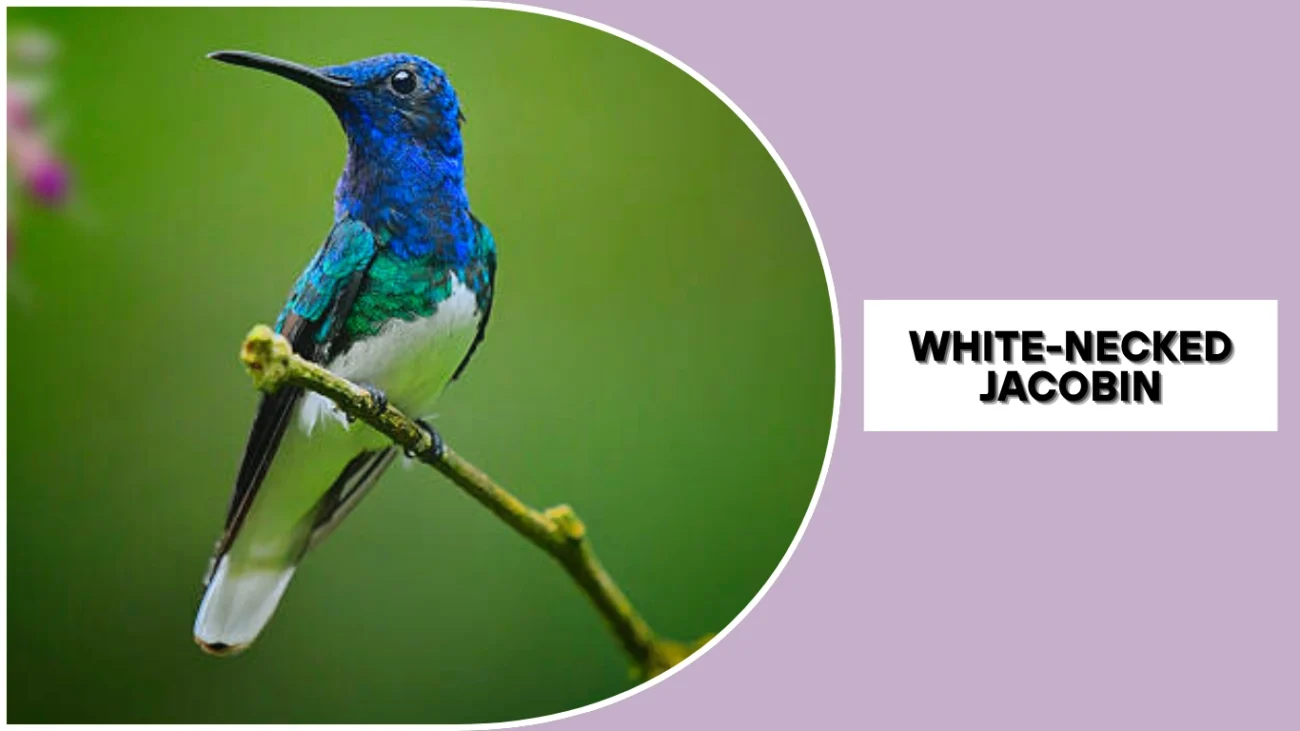
The White-necked Jacobin is a tropical hummingbird known for its bold coloring and energetic personality. Often seen at feeders and forest edges, it’s a common and photogenic species in Central and northern South America.
Identification
- Medium to large size (about 4.3–4.7 inches long)
- Males have a vivid blue head and chest, white belly, and green back
- A distinct white collar and undertail
- Females are variable: green above with whitish or speckled underparts
- Straight, medium-length black bill
Habitat
Found in lowland rainforests, gardens, and forest edges from southern Mexico to the Amazon Basin. Frequently seen in flowering trees and near forest clearings.
Behavior
White-necked Jacobins are bold and active. Males often display in small groups and defend feeding territories. They’re also known to hover acrobatically while feeding or displaying.
Color Pattern
Males exhibit vivid blue, white, and green coloration with a glossy sheen. Females can be difficult to identify due to their variation, but they generally show white or grayish underparts with green upperparts.
28. Crowned Woodnymph

The Crowned Woodnymph is a dazzling, medium-sized hummingbird found in tropical forests from Central to northern South America. Its glowing green and violet plumage make it one of the most visually stunning species in its range.
Identification
- Medium size (about 4–4.5 inches long)
- Males have an iridescent emerald green body with a deep violet-purple crown, belly, and tail
- Females are green above with grayish-white underparts
- Long, slightly curved black bill
- Compact body and rapid wingbeats
Habitat
Common in lowland and foothill rainforests, forest edges, and plantations from Honduras to northern South America, including the Amazon Basin.
Behavior
Males are territorial and often perch openly while guarding food sources. Crowned Woodnymphs feed actively on a wide range of flowers and frequently visit feeders in shaded forested areas.
Color Pattern
Males shimmer with emerald and violet tones depending on the angle of light, especially on the head and belly. Females are more muted but still show metallic green above and clean, pale underparts.
29. Black-tailed Trainbearer
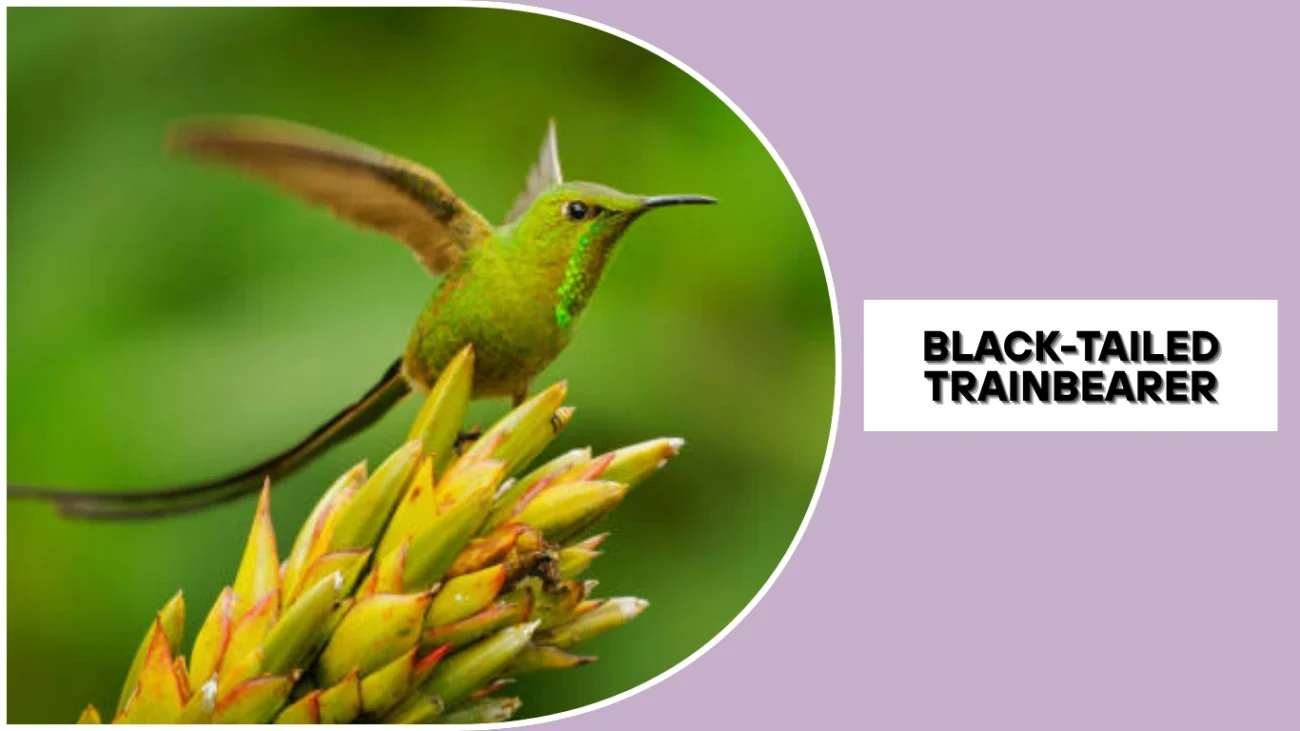
The Black-tailed Trainbearer is a long-tailed, slender hummingbird found in the Andean regions of South America. It’s named for the male’s dramatic tail feathers, which trail behind it like streamers.
Identification
- Medium size (body length about 4 inches; tail may double that)
- Males have a long, deeply forked black tail and iridescent green body
- Females have a shorter tail, speckled throat, and white underparts
- Long, decurved black bill
- Streamlined, elegant shape
Habitat
Found in open woodlands, montane scrub, and gardens in the Andes from Venezuela to Bolivia, typically between 6,000–12,000 feet elevation.
Behavior
These hummingbirds are strong, agile fliers that patrol territories and feed on tubular flowers. Males perform flight displays, often flying in wide arcs to show off their long tails.
Color Pattern
Males flash vibrant green on the body and throat with a long black tail that trails behind in flight. Females are more subdued with white bellies, green backs, and short, slightly forked tails.
30. Sword-billed Hummingbird

The Sword-billed Hummingbird is one of the most extraordinary species in the hummingbird family, famous for its incredibly long bill—longer than the rest of its body. This unique adaptation allows it to feed from deep tubular flowers that few others can reach.
Identification
- Large size (about 5.5 inches body length, bill up to 4 inches)
- Long, straight, sword-like bill
- Metallic green body with a bronzy back
- Blackish wings and tail
- Males and females appear similar
Habitat
Inhabits cloud forests and high-altitude Andean valleys from Venezuela to Bolivia, usually at elevations of 7,000–10,000 feet. Prefers areas rich in long-tubed flowers such as passionflowers and trumpet vines.
Behavior
Feeds by hovering in front of deep flowers, inserting its long bill without needing to land. The bird uses its feet to preen since it can’t use its bill due to its extreme length. It is solitary and territorial, often guarding favored feeding spots.
Color Pattern
Glowing green body with a bronze shimmer on the wings and back. The enormous bill gives it a striking, unmistakable silhouette among all birds, not just hummingbirds.
31. Booted Racket-tail

The Booted Racket-tail is a tiny, highland hummingbird known for its unique tail and fuzzy white “boots” on its legs. Found in the Andes, it’s a favorite among birdwatchers for its lively behavior and adorable appearance.
Identification
- Small size (about 3–4 inches including tail)
- Males have two long tail streamers ending in oval, racket-shaped tips
- Both sexes have fluffy white feather tufts (“boots”) on their legs
- Males are green with a sparkling throat
- Females have a shorter tail and white underparts
Habitat
Found in Andean cloud forests from Venezuela to Bolivia, typically between 5,000–10,000 feet elevation. Prefers forest edges, clearings, and flowering shrubs.
Behavior
Males often perch on high branches or hover near favorite flowers. Their fluttering flight and distinctive tail movements make them easy to spot despite their size. They also display tail-flicking and aerial courtship behaviors.
Color Pattern
Males shimmer in emerald green with long dark tail streamers tipped in rounded “rackets.” The white leg puffs are clearly visible during flight. Females are subtler but still show the white boots and metallic green backs.
32. Wire-crested Thorntail

The Wire-crested Thorntail is a dazzling and rare hummingbird found in the Andean foothills of South America. It gets its name from the thin, wiry crest on the male’s head and its needle-like tail feathers.
Identification
- Very small size (about 3–3.5 inches long)
- Males have a wire-like green crest and long, narrow tail feathers
- Iridescent green body with a bluish throat
- Females lack the crest and have a shorter, forked tail
- Both sexes have a slim, straight black bill
Habitat
Found in subtropical forests and foothill edges of the eastern Andes from Ecuador to Bolivia, usually between 3,000–6,000 feet elevation. Prefers areas with scattered flowering shrubs and low trees.
Behavior
Often seen hovering around small flowers in the mid-canopy or undergrowth. Males perform short, zig-zag flight displays. Despite its flashy appearance, it is quiet and not especially territorial.
Color Pattern
Males shine with a deep emerald green body and glittering blue throat. The wire-like green crest and long tail give it an unusual silhouette. Females are more subdued, with green upperparts and buffy underparts.
33. Green-crowned Brilliant
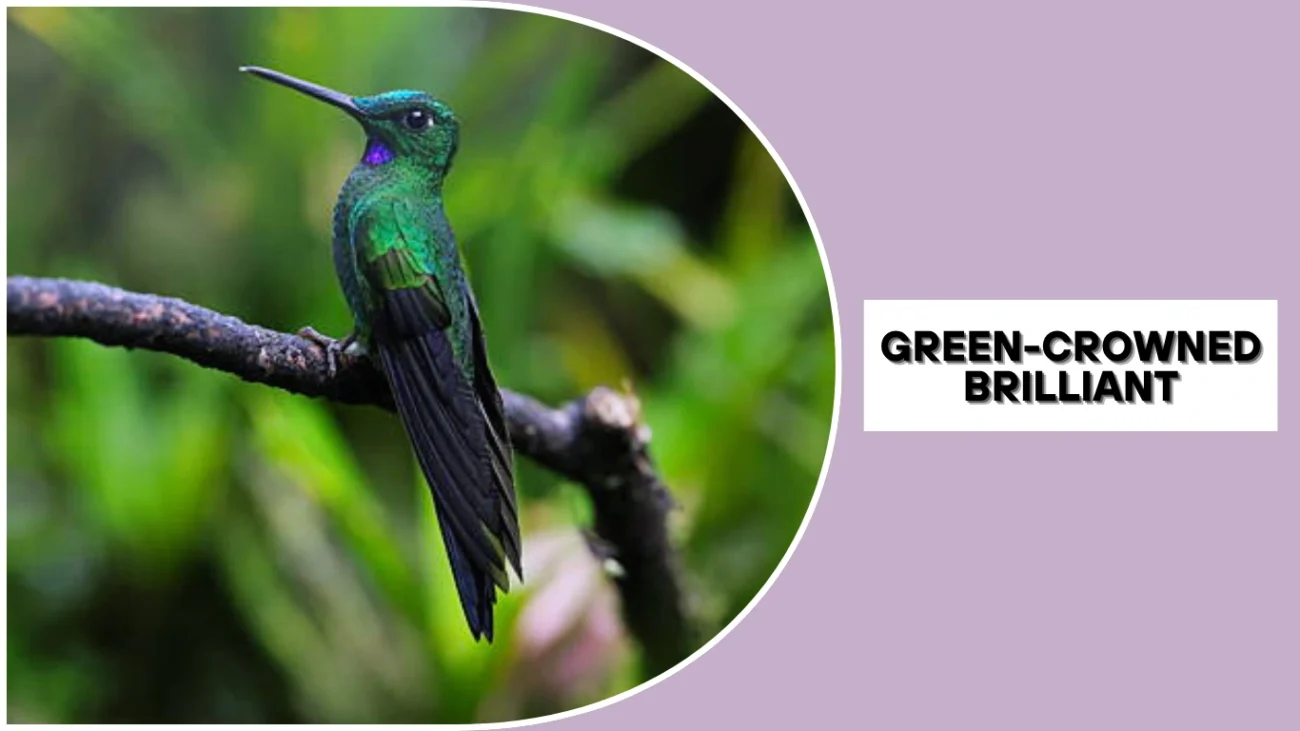
The Green-crowned Brilliant is a large, showy hummingbird that lives in the humid forests of Central and northern South America. Known for its size and glowing green crown, it is a frequent visitor to cloud forest feeders.
Identification
- Large size (about 4.7–5 inches long)
- Males have a glittering green crown and throat with blue-violet patches
- Females are similar but have white spots on the throat and chest
- Thick, slightly curved bill
- Long tail, slightly notched
Habitat
Common in cloud forests, forest edges, and shady gardens from Costa Rica to western Colombia and Ecuador, usually at elevations from 2,000 to 7,000 feet.
Behavior
Bold and often dominant at feeders, especially in mid-elevation lodges. It also feeds from large tropical flowers and is known to hover or perch while feeding. Males often display with loud wing beats and tail flicks.
Color Pattern
Males are a rich emerald green with a brilliant crown and throat. Females show a similar green back with a speckled white underside, making them easy to recognize at feeders or along forest trails.
34. Shining Sunbeam
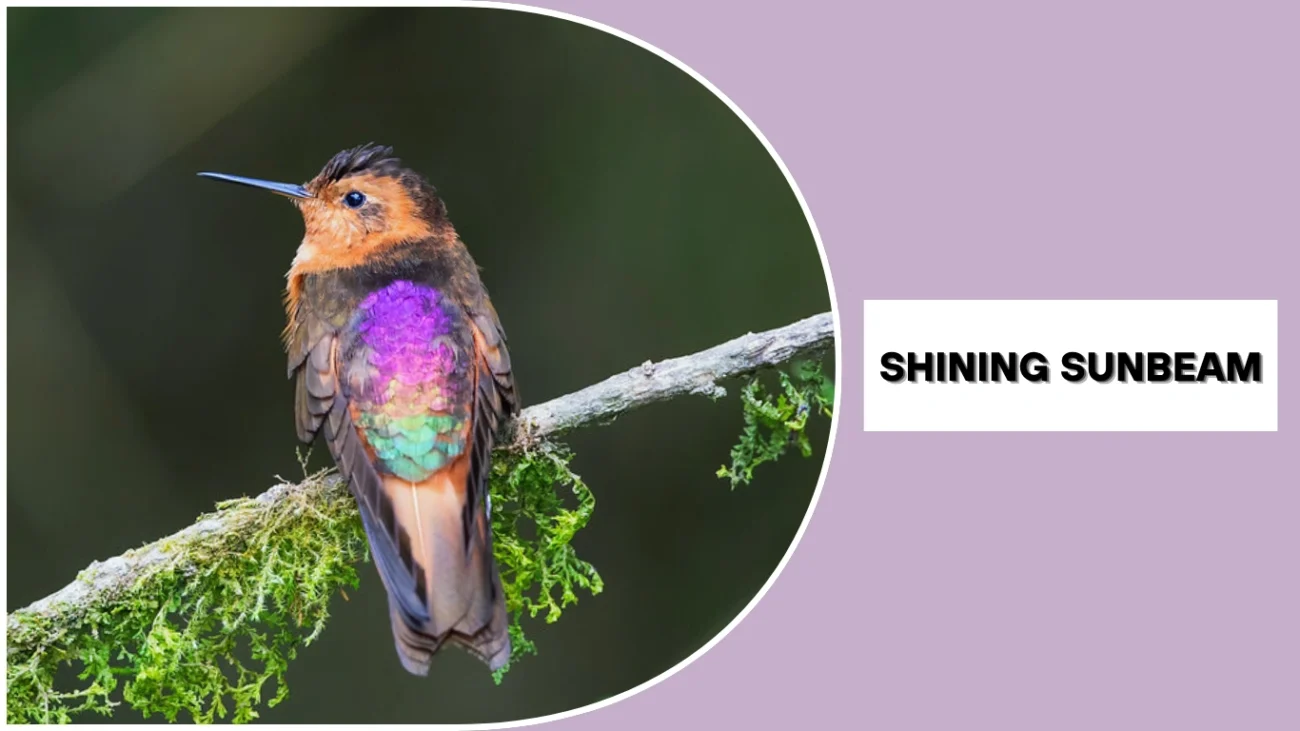
The Shining Sunbeam is a unique high-altitude hummingbird known not for vibrant iridescence, but for its warm, coppery glow. Its bronzy plumage reflects light like a polished metal, creating a subtle but striking shimmer in the Andean sunlight.
Identification
- Medium to large size (about 5 inches long)
- Broad wings and slightly forked tail
- Thick, straight black bill
- Both sexes are similar in appearance
- Compact body and long, tapered shape
Habitat
Inhabits high-elevation montane scrub, grasslands, and Polylepis woodlands in the Andes from Colombia to Bolivia, often between 9,000–13,000 feet.
Behavior
Feeds low to the ground at flowering shrubs or cushion plants. Often perches on rocks or small branches and frequently chases away other hummingbirds. It’s adapted to cold temperatures and winds typical of high elevations.
Color Pattern
Warm bronze to cinnamon-brown with a golden-bronze rump and back. Lacks the typical glittering gorget but glows in natural light like burnished metal, earning its poetic name.
35. Ecuadorian Hillstar
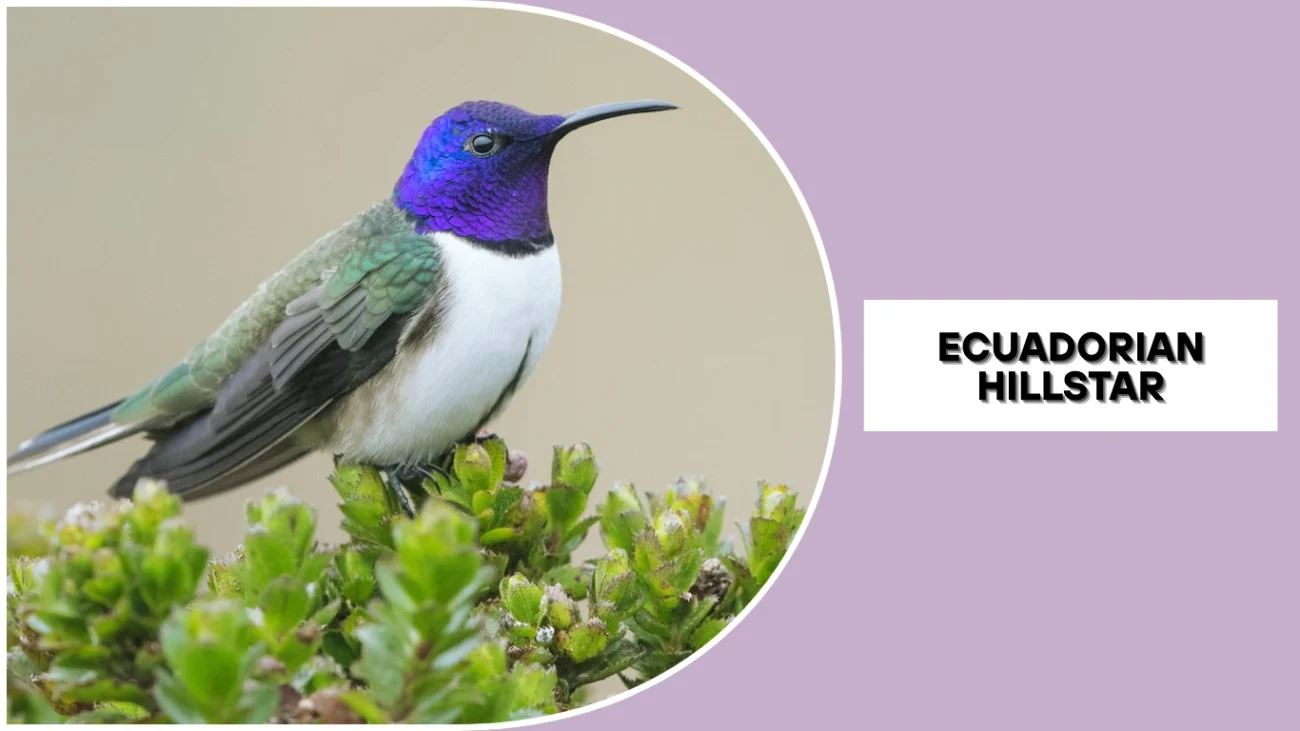
The Ecuadorian Hillstar is a hardy, cold-weather hummingbird that thrives in the windswept páramo of the Andes. One of the few hummingbirds adapted to frigid climates, it often perches to conserve energy between feeding bouts.
Identification
- Medium size (about 4–4.3 inches long)
- Males have a white underside, green back, and a brilliant violet-purple throat
- Females are greenish above with pale underparts
- Short, straight black bill
- Sturdy body and short wings
Habitat
Found exclusively in the high Andes of Ecuador and southern Colombia, usually above 11,000 feet. Prefers alpine grasslands and páramo habitats where chuquiraga shrubs bloom.
Behavior
Feeds from low shrubs close to the ground and spends much time perched to preserve energy. Nests in sheltered rocky outcrops or caves to avoid extreme weather. One of the few hummingbirds that roost at night in cold conditions.
Color Pattern
Males display a vivid violet throat and crisp white belly contrasted by green upperparts. Females are plainer but still have the compact, frost-hardy build typical of this alpine specialist.