











The Yellow Bittern (Ixobrychus sinensis) is one of Asia’s smallest and most elusive herons, known for its remarkable ability to blend seamlessly into reed beds. This delicate wader inhabits freshwater marshes, rice paddies, and mangrove edges, moving quietly through dense vegetation. Despite its small size, the Yellow Bittern displays striking agility and grace in flight, making it a favorite among birdwatchers and nature photographers who admire its subtle beauty and cryptic behavior.
Identification

Scientific Classification
The Yellow Bittern belongs to the family Ardeidae, which includes herons, egrets, and bitterns. Its scientific name, Ixobrychus sinensis, reflects its strong association with wetlands across Asia. Commonly known as the Chinese Bittern or Little Yellow Bittern, this species is categorized as Least Concern on the IUCN Red List due to its broad distribution and stable population numbers.
Physical Description and Size
Small and slender, the Yellow Bittern measures around 36–40 centimeters in length with a wingspan of 55–60 centimeters. Males exhibit a pale yellow-brown body with a chestnut crown and dark brown back, while females are slightly duller, with heavier streaks across the neck and breast. The underparts are pale, and the long, yellowish legs aid in wading through shallow waters.
When perched among reeds, its vertical posture and streaked plumage create a perfect camouflage. Even experienced birders may overlook it as it freezes motionless, mimicking the surrounding vegetation.
Juvenile Characteristics
Juveniles are noticeably streaked with brown and cream plumage, providing them with excellent concealment against reed stems. Their bills and legs have a greener tint than adults, and the chestnut crown is absent. As they mature, the plumage lightens, and yellowish hues appear on the underparts, giving them the elegant coloration typical of adult bitterns.
Habitat and Distribution
The Yellow Bittern thrives in tropical and subtropical wetlands, ranging from India and China to Japan, Indonesia, and the Philippines. It prefers dense reed beds, freshwater marshes, rice fields, and mangrove swamps, often near still or slow-moving water.
It is both resident and migratory, depending on location. Northern populations, such as those in China and Japan, migrate southwards during winter to warmer areas, including Southeast Asia and the Indonesian archipelago. In regions like Singapore and the Philippines, it remains a year-round resident.
This bittern’s adaptability allows it to survive even in semi-urban wetlands, where it may be seen perched motionless near ponds or canals. Despite living near human settlements, it remains secretive, rarely venturing into open water and quickly retreating into reeds when disturbed.
Behavior and Flight
Flight Pattern
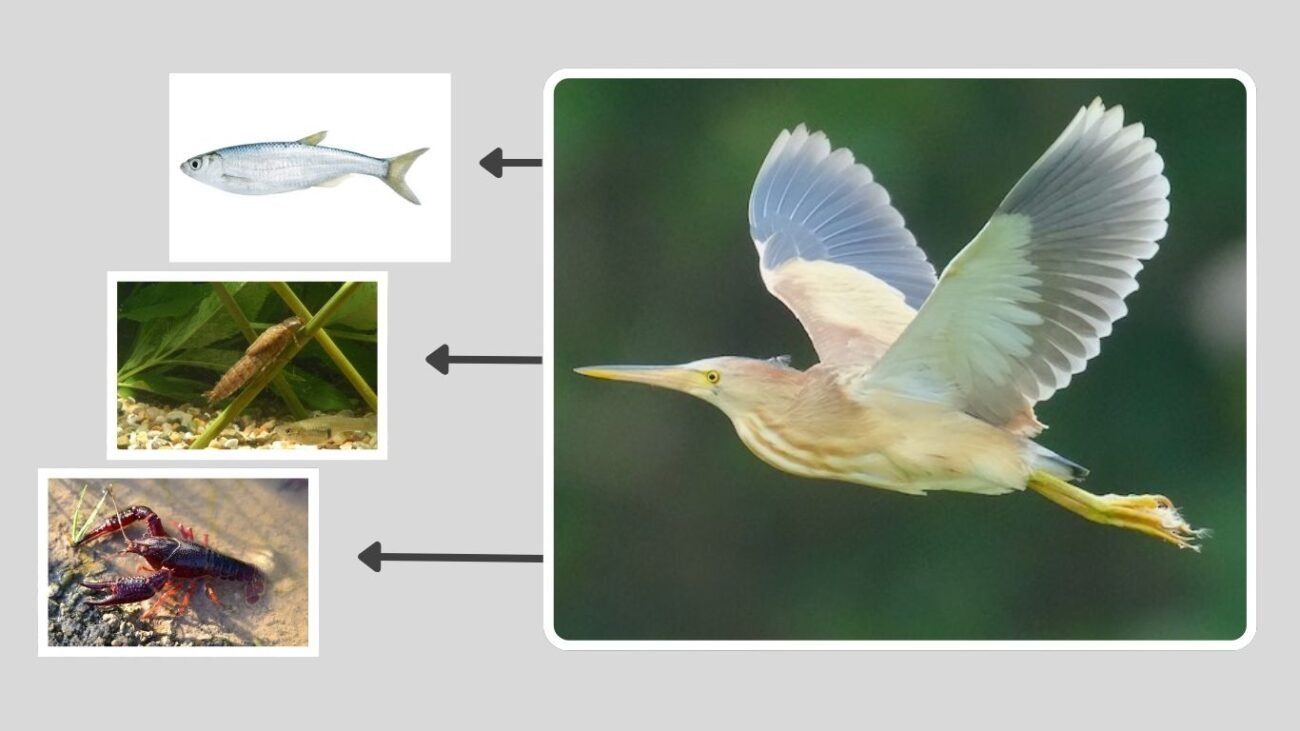
The Yellow Bittern’s flight is fast, low, and fluttering—usually close to the surface of the water. Its wings are short and rounded, producing rapid beats that help it maneuver through narrow reed corridors. When startled, it often bursts from the reeds with sudden speed, flying a short distance before diving back into cover. This zigzag flight pattern makes it challenging to track.
During non-breeding seasons, it tends to stay hidden, emerging mostly at dawn or dusk when light levels are low. The compact body, short neck, and quick wingbeats give it a distinctive silhouette compared to larger herons.
Feeding Habits
The Yellow Bittern feeds primarily on small fish, frogs, crustaceans, insects, and aquatic larvae. It practices a “stand-and-wait” technique, remaining still for long periods before striking with lightning speed. Its sharp, pointed bill and flexible neck allow it to spear prey efficiently in shallow water.
This solitary hunter often positions itself among reeds, extending its neck horizontally to remain hidden. Once prey moves within reach, the bittern’s strike is swift and precise. Occasionally, it wades slowly through shallow areas or climbs vegetation to spot food from above.
Sound and Communication
Unlike many herons, the Yellow Bittern is remarkably quiet, relying more on stealth than sound. However, during the breeding season, males produce a low, booming or croaking call that echoes softly through dense reeds. These calls are used to mark territory and attract mates, often heard at dawn or dusk.
The typical call can be described as a muted “woop” or “grrk”, repeated several times in short intervals. When alarmed, it emits a sharper sound resembling a grunt or hiss. Outside of breeding months, the bird remains almost completely silent, adding to its mysterious reputation among wetland observers.
Reproduction
The Yellow Bittern breeds in dense reed beds or papyrus thickets, typically close to shallow water. Its nest is a compact platform of reeds and grass, concealed within tall vegetation. Both parents participate in incubation and chick feeding, showing strong parental cooperation uncommon in many waders.
Clutch size ranges from four to six pale blue eggs, and the incubation period lasts about 18–20 days. The chicks hatch with downy feathers and are fed regurgitated food until they can leave the nest after two weeks. Breeding season varies across its range but generally peaks between April and August, coinciding with wet seasons that provide abundant food.
Controversy and Cultural Significance
While the Yellow Bittern is admired for its quiet beauty, it has occasionally been at the center of identification controversies. Birdwatchers sometimes confuse it with the Cinnamon Bittern (Ixobrychus cinnamomeus) or Little Bittern (Ixobrychus minutus), due to similar size and coloration. The distinction often lies in subtle traits—like the Yellow Bittern’s paler underparts, shorter bill, and more rounded wings.
In some regions, especially in traditional Asian folklore, this species holds symbolic meaning. It represents patience, subtlety, and reflection, qualities mirrored in its silent movements through reeds. The bird’s mysterious lifestyle has made it a recurring image in poetry and art, where it embodies the quiet power of nature and solitude.
In Literature and Art

The Yellow Bittern is immortalized in classical Chinese and Japanese poetry, where it often symbolizes the beauty of stillness and restraint. One of the most famous references comes from Wen Tingyun’s ancient Chinese poem “The Yellow Bittern.” In this work, the bird’s solitude and vulnerability in the marshlands are metaphors for the transient nature of life and human emotion.
In Japanese literature, it appears in haiku and tanka, celebrated for its calm grace amid the chaos of the natural world. The Yellow Bittern’s quiet demeanor and ability to vanish among reeds reflect the Zen philosophy of impermanence—that beauty often lies in what is fleeting and unseen.
Artists across Asia have also captured the bird in traditional ink paintings and scrolls, emphasizing its minimalistic elegance. Often shown among golden reeds or by tranquil ponds, it represents harmony and mindfulness in visual art traditions.
Observation and Conservation
Current Status
The IUCN Red List classifies the Yellow Bittern as Least Concern, indicating a stable global population. Its extensive distribution across South, Southeast, and East Asia provides resilience against localized threats. However, habitat loss remains a major concern, particularly in rapidly developing regions where wetlands are drained for agriculture or urbanization.
Threats
Key challenges include:
- Destruction of reed beds for urban development
- Pollution of wetlands from pesticides and runoff
- Climate change, which alters wetland water levels
- Rice field mechanization, reducing suitable nesting grounds
Despite these issues, the species adapts well to modified habitats, including rice paddies and artificial wetlands, where it continues to breed successfully.
Conservation Efforts
Conservationists emphasize the protection of wetland ecosystems, not only for the Yellow Bittern but for countless species that depend on them. Governments in countries like India, Japan, and Singapore have initiated wetland restoration projects, which help sustain breeding populations. Birdwatching platforms such as eBird have also played a role in tracking population trends, raising awareness of its ecological importance.
Behavioral Uniqueness
Unlike larger herons, the Yellow Bittern often relies on cryptic behavior rather than flight to escape threats. When alarmed, it freezes with its bill pointing upward, blending seamlessly with surrounding reeds—a behavior known as bitterning. This posture, along with its vertical streaks, breaks up its outline and makes it nearly invisible.
During the breeding season, males may engage in short courtship flights, circling above reeds with soft calls before descending to hidden nesting sites. These displays are subtle yet essential to pair formation.
Ecological Role
The Yellow Bittern contributes significantly to the balance of wetland ecosystems. By preying on insects, small fish, and amphibians, it helps control aquatic populations and maintain food chain stability. Its nesting habits among reeds also create microhabitats for other small wetland creatures, adding to biodiversity.
Because it is sensitive to environmental changes, the Yellow Bittern serves as an indicator species—its presence reflects the health of a wetland. Areas where it thrives usually indicate clean, stable, and undisturbed aquatic environments.
FAQs
What is the scientific name of the Yellow Bittern?
The Yellow Bittern’s scientific name is Ixobrychus sinensis. It belongs to the heron family Ardeidae and is one of the smallest bittern species in Asia. The name “sinensis” refers to its strong presence in East Asia, particularly China and neighboring countries.
How large is the Yellow Bittern?
This tiny heron measures about 36–40 centimeters in length with a wingspan of 55–60 centimeters. Despite its size, it is an agile flier capable of quick, darting movements over water. Males are slightly larger and more vividly colored than females.
What sound does the Yellow Bittern make?
The bird is mostly silent but produces low booming or croaking calls during breeding season. These deep, muffled sounds are used to mark territory and attract mates. Outside of the breeding period, it rarely vocalizes, making it one of the quietest herons.
Where does the Yellow Bittern live?
It inhabits wetlands, reed beds, and rice paddies across South, Southeast, and East Asia, including countries like India, Japan, China, Indonesia, and the Philippines. It prefers dense vegetation near freshwater sources where it can hide and hunt efficiently.
Why is the Yellow Bittern featured in poetry?
The Yellow Bittern symbolizes modesty, patience, and solitude in Asian literature. Poets such as Wen Tingyun used it as a metaphor for life’s fragility and the harmony between stillness and survival. Its quiet presence continues to inspire art and spiritual reflection today.


