










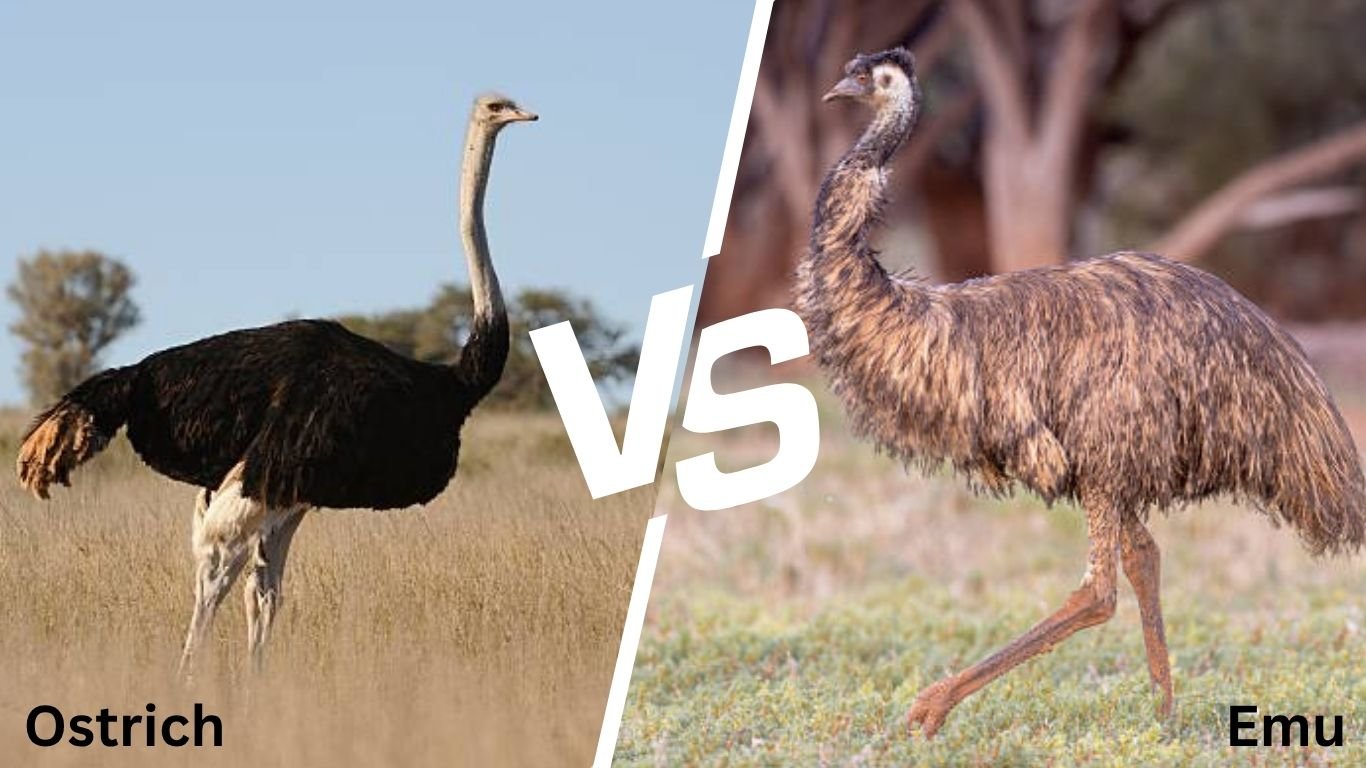
The ostrich and the emu are two of the largest birds in the world, often mistaken for one another because of their similar looks and flightless nature. Yet, despite belonging to the same ancient ratite family, these giants are separated by continents, evolution, and distinctive traits. From Africa’s open savannas to Australia’s vast plains, both birds have adapted perfectly to their environments in fascinatingly different ways.
Understanding the Ostrich and the Emu
Both the ostrich (Struthio camelus) and the emu (Dromaius novaehollandiae) belong to the ratite group — a family of large, flightless birds that also includes cassowaries, rheas, and kiwis. Ratites share flat breastbones with no keel, which prevents flight but allows for strong leg muscles adapted to running.
People often confuse ostriches and emus because they look similar, with long legs, long necks, and small heads. However, their differences in size, habitat, and behavior show that each bird has evolved uniquely according to its region.
Classification and Evolutionary Relationship
Scientific Classification
- Ostrich: Struthio camelus – native to Africa
- Emu: Dromaius novaehollandiae – native to Australia
Both birds belong to the Palaeognathae order, which translates to “ancient jaw.” Their bone structures are primitive compared to flying birds, linking them to early avian ancestors.
Evolutionary Background
Millions of years ago, before the continents drifted apart, a single group of ancient flightless birds spread across the supercontinent Gondwana. When Africa and Australia separated, the ostrich and emu evolved independently to suit their environments.
Ostriches developed into powerful runners across the African savannas, while emus became resilient survivors in Australia’s unpredictable climate. Their shared lineage still connects them as distant cousins in the bird world.
Geographic Range and Habitat
Where Ostriches Live
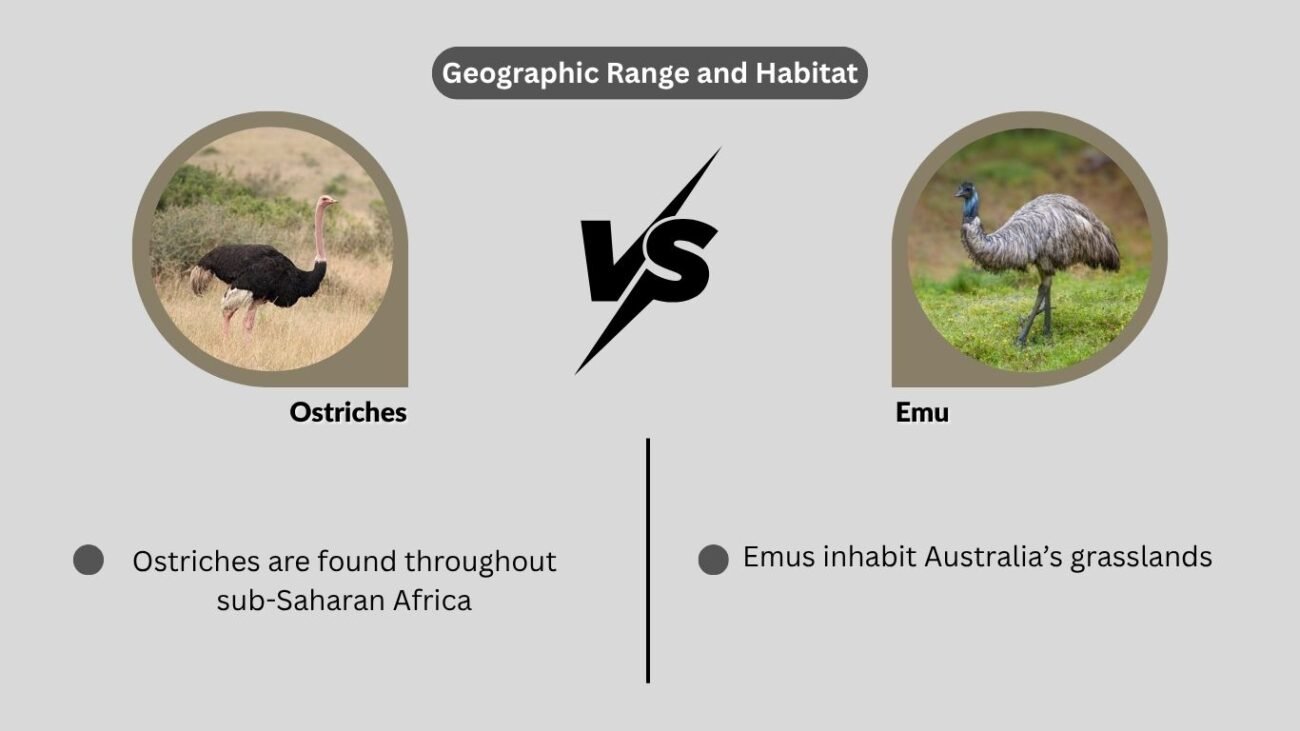
Ostriches are found throughout sub-Saharan Africa, thriving in open grasslands, savannas, and semi-desert regions. They prefer areas with wide visibility, where their height and sharp eyesight help them detect predators like lions and cheetahs. Ostriches also live near sparse vegetation, feeding on dry grasses, seeds, and shrubs.
Their natural range includes South Africa, Namibia, Botswana, Kenya, Tanzania, and Ethiopia. In these environments, temperatures can soar above 100°F (38°C), yet ostriches remain active thanks to their heat-resistant adaptations and minimal water needs.
Where Emus Live
Emus inhabit Australia’s grasslands, woodlands, and semi-arid plains. They are highly adaptable and often migrate seasonally, following rainfall to find fresh vegetation. Unlike ostriches, emus live in regions with more trees and cooler conditions.
Their range covers nearly all of mainland Australia, except for dense tropical forests and very dry desert centers. They are known for their stamina, often walking long distances in search of food and water.
Habitat Comparison
While ostriches and emus both prefer open areas, ostriches favor hot, dry savannas, whereas emus thrive in mild, grassy, and bushy terrains. This environmental difference has shaped their diets, body size, and even coloration.
Physical Appearance and Size
Height and Weight
The ostrich is the largest living bird, standing up to 9 feet (2.7 meters) tall and weighing between 250–350 pounds (113–160 kg). In contrast, the emu reaches around 6 feet (1.8 meters) in height and weighs 120–150 pounds (55–70 kg).
The ostrich’s towering height and heavier build make it a dominant figure of the African plains, while the lighter emu is designed for long-distance movement rather than sheer size.
Feathers and Wings
Both birds are flightless, but their feathers serve different purposes. The ostrich has large, soft feathers that keep it cool during the day and warm at night. Its wings are long and used for balance, mating displays, and shading chicks.
The emu, on the other hand, has shaggy, double-layered feathers that act as natural insulation. These feathers protect it from both the harsh Australian sun and cold nights. Its smaller wings help with steering while running, similar to the ostrich.
Color and Appearance
Male ostriches have striking black feathers with white wingtips, while females display grayish-brown plumage for camouflage. Emus, in contrast, are covered in brown or gray feathers with a subtle iridescent sheen that helps them blend into their bushland environment.
Both species have long, bare necks and legs — evolutionary traits that reduce heat retention and improve speed.
Speed, Movement, and Strength
How They Move
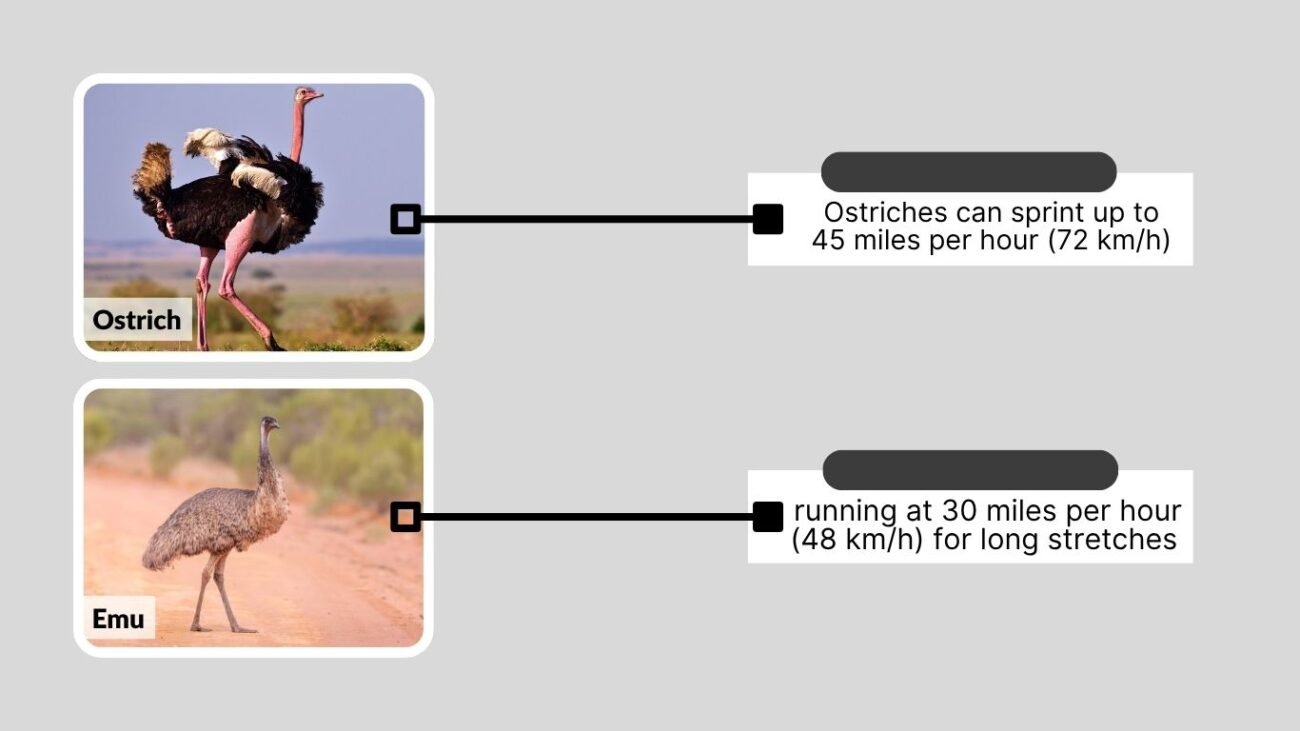
Ostriches and emus are exceptional runners, built for covering large distances on land. Ostriches can sprint up to 45 miles per hour (72 km/h), making them the fastest birds on land. Their long legs allow a stride length of 10–16 feet with each step.
Emus are slower but have greater endurance, running at 30 miles per hour (48 km/h) for long stretches. Their legs have three toes compared to the ostrich’s two, offering better grip on varied terrain.
Leg Power and Defense
The ostrich’s legs are not only strong but deadly. Each kick can deliver enough force to seriously injure predators, aided by a sharp claw on the main toe. Emus use a different defense method — quick directional changes and zigzag running patterns to escape threats.
Both birds rely on their legs for survival, whether in open deserts or Australian grasslands. Their massive muscles and spring-like tendons store energy efficiently, allowing them to move swiftly despite their weight.
Behavior and Social Structure
Group Dynamics
Ostriches are social animals, living in flocks of 5–50 birds depending on food availability. These groups are led by a dominant male and include several females and juveniles. Living in groups helps them watch for predators across vast open land.
Emus, in contrast, are more solitary or live in pairs, especially during breeding season. However, they can form temporary flocks when food is plentiful or during migration periods.
Daily Routine
Both species are most active in the early morning and late afternoon when temperatures are cooler. Ostriches spend much of their time grazing, dust bathing, and socializing. Emus tend to wander continuously in search of food and can cover up to 15 miles (24 km) a day.
Diet and Feeding Habits
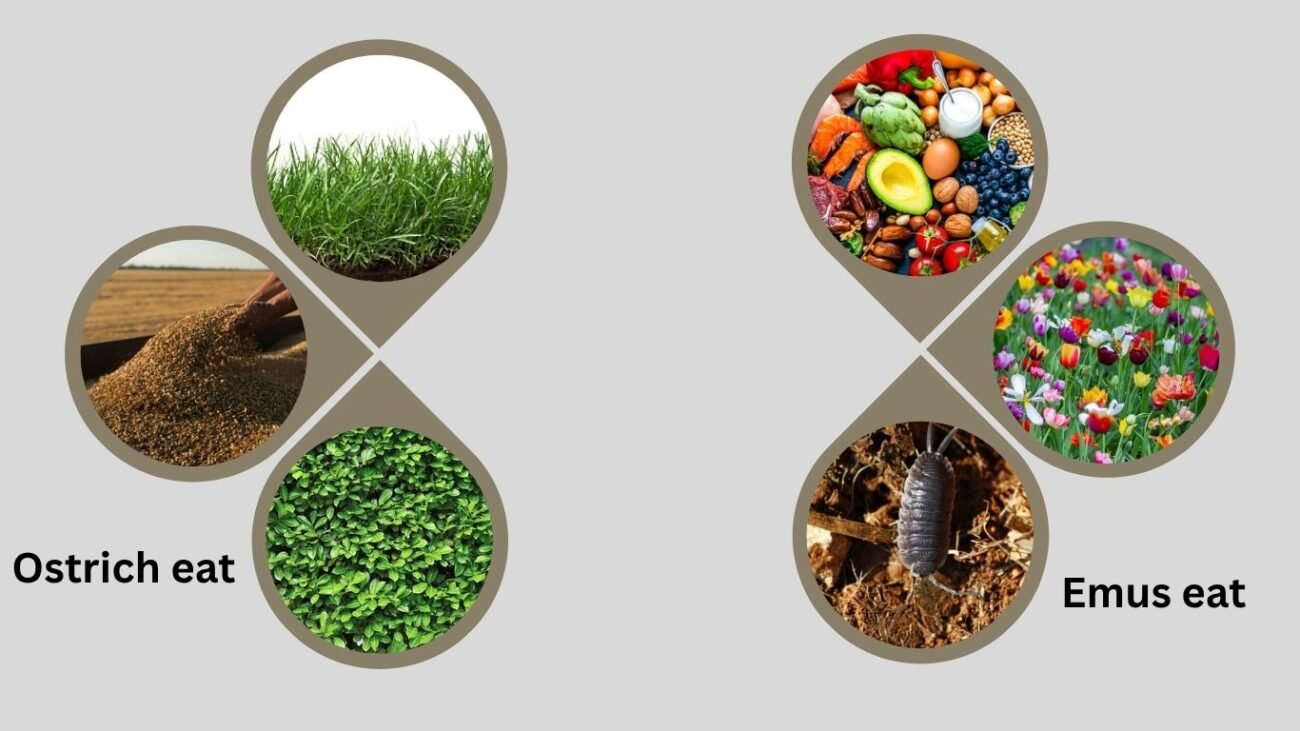
Ostriches and emus are both omnivorous, meaning they eat a mix of plant and animal matter. Their diets largely depend on seasonal availability in their environments.
Ostriches consume grasses, seeds, shrubs, roots, and small insects. In dry areas, they rely on plants rich in moisture, allowing them to survive for weeks without direct water intake.
Emus eat fruits, seeds, flowers, and small invertebrates. After heavy rains, they feast on new plant growth and insects, which helps them store body fat for migration across the dry interior of Australia.
Both birds swallow small stones, known as gastroliths, which help grind food in their muscular stomachs, aiding digestion since they lack teeth.
Mating, Nesting, and Parental Care
Reproduction Differences
Ostriches and emus have contrasting reproductive systems. Ostriches are polygamous, where one dominant male mates with several females. The group shares a communal nest, but only the dominant pair incubates the eggs.
Emus, however, are monogamous. A single male and female pair up during the breeding season, and after the eggs are laid, the male takes over full incubation duties while the female leaves to find another mate.
Eggs and Nesting
An ostrich egg is the largest in the world, weighing up to 3 pounds (1.4 kg) and measuring about 6 inches (15 cm) in diameter. Emu eggs, while smaller, are remarkable for their deep green-blue color and thick shells.
Emu males build shallow ground nests using grass and leaves, while ostriches dig a large sandy pit to keep eggs partially hidden. The emu male incubates the clutch for eight weeks without eating or drinking, a unique dedication among birds.
Lifespan and Adaptations
Longevity
Ostriches live longer than emus — up to 40–50 years in the wild, and even longer in captivity. Emus usually survive 20–30 years, though farmed birds may live shorter lives depending on conditions.
Adaptations for Survival
Ostriches thrive in the hot, dry savannas thanks to specialized feathers that regulate body temperature and long legs that lift their bodies off the hot ground. Their eyesight is among the best in the animal kingdom, spotting predators miles away.
Emus, adapted to Australia’s variable climate, have thick plumage for insulation, and their strong legs allow them to travel vast distances for food. They are also excellent swimmers, capable of crossing rivers and shallow lakes when migrating.
Birds Similar to Ostrich and Emu
The Ratite Family
Both birds belong to the ratite family, which includes other large flightless birds like:
- Cassowary – Found in New Guinea and northern Australia; known for its bright neck and dangerous claws.
- Rhea – Native to South America’s grasslands; resembles a smaller version of the ostrich.
- Kiwi – A small, nocturnal bird native to New Zealand with a long beak and strong legs.
Shared Traits
All ratites share flightlessness, strong legs, and a flat breastbone (no keel for flight muscles). However, their adaptations differ depending on environment — each species evolved to fill a specific ecological niche after the breakup of the supercontinent Gondwana.
Human Interaction and Farming

Ostrich and Emu Farming
Both birds are commercially farmed for meat, leather, feathers, and oil.
Ostrich leather, recognized for its unique quill pattern, is used in luxury fashion for handbags, boots, and belts. Emu oil, extracted from body fat, is prized for its anti-inflammatory and skincare benefits.
Ostrich farms are common in South Africa and Namibia, while emu farming thrives in Australia, India, and the United States. Both industries contribute to sustainable rural economies by promoting eco-friendly livestock alternatives.
Conservation and Management
Neither species is endangered, though wild populations depend on habitat protection. Ostriches benefit from Africa’s national parks and reserves, while emus are protected under Australian wildlife laws. Conservation programs focus on habitat restoration and preventing overhunting for commercial gain.
Key Comparison: Ostrich vs Emu
| Feature | Ostrich | Emu |
| Scientific Name | Struthio camelus | Dromaius novaehollandiae |
| Continent | Africa | Australia |
| Height | Up to 9 ft (2.7 m) | Up to 6 ft (1.8 m) |
| Weight | Up to 350 lb (160 kg) | 120–150 lb (55–70 kg) |
| Speed | 45 mph (72 km/h) | 30 mph (48 km/h) |
| Egg Color | Creamy white | Deep green-blue |
| Mating System | Polygamous | Monogamous |
| Parental Care | Male + dominant female | Male incubates and raises chicks |
| Lifespan | 40–50 years | 20–30 years |
FAQs
Which is the largest bird, the ostrich or the emu?
The ostrich is the world’s largest bird, reaching up to 9 feet in height and weighing over 300 pounds. The emu ranks second, standing around 6 feet tall.
Are ostriches and emus related?
Yes. Both belong to the ratite family of flightless birds, sharing a distant ancestor before Africa and Australia separated millions of years ago.
Which is faster, the ostrich or the emu?
Ostriches are faster, capable of sprinting at 45 mph (72 km/h), while emus can run at 30 mph (48 km/h) with better endurance.
Do emus and ostriches live together?
No. Ostriches live in Africa, while emus are native to Australia. They have never naturally coexisted, though both species can be found on farms worldwide.
What other birds are like ostriches and emus?
Other relatives include cassowaries, rheas, and kiwis — all part of the ratite group of large, flightless birds that evolved separately on different continents.


