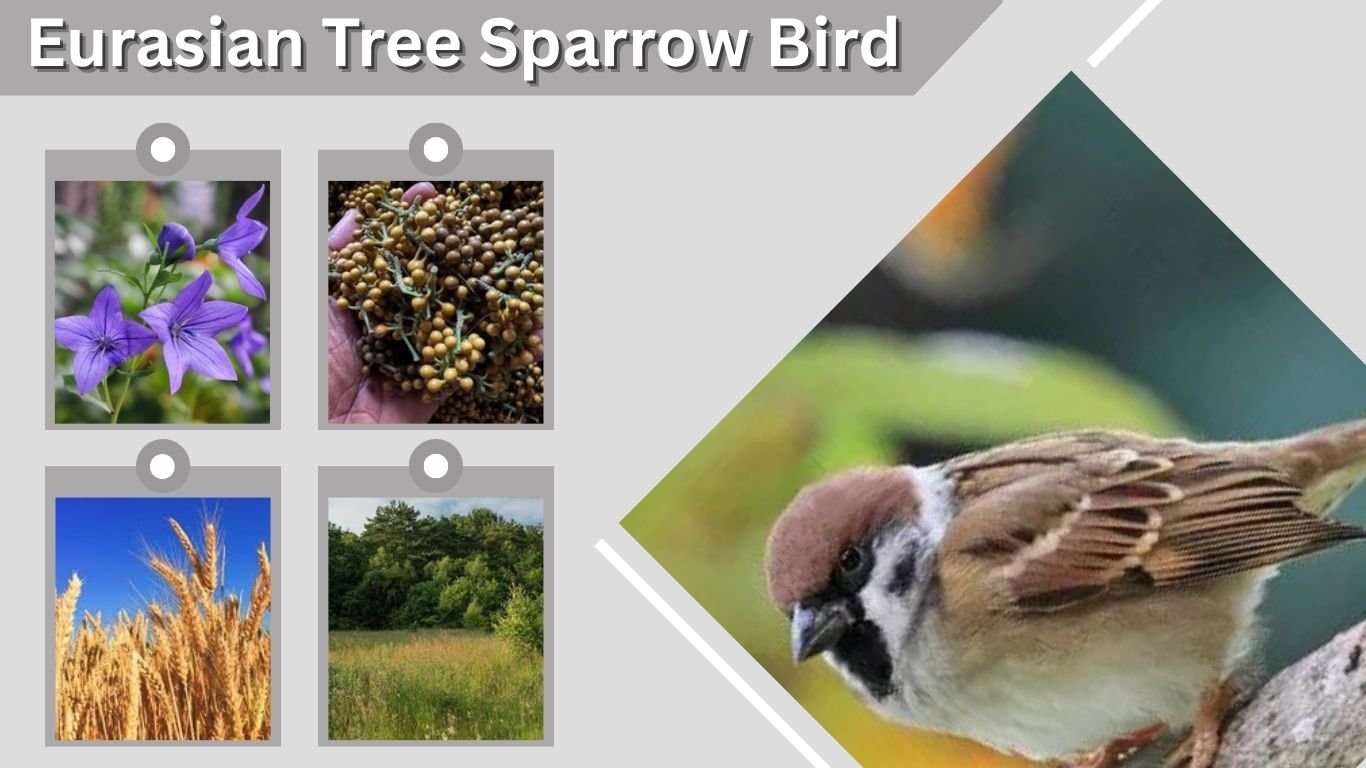
The Eurasian Tree Sparrow bird is a small, social sparrow with a chestnut-brown cap, white cheeks, and a bold black cheek spot. Its scientific name is Passer montanus. Although it is native across Europe and Asia, it is also found in a limited part of North America, especially around St. Louis, Missouri. This bird is often confused with the House Sparrow, but its clean cheek patch, smaller size, and similar-looking male and female make it easier to identify.
What Is a Eurasian Tree Sparrow Bird?
The Eurasian Tree Sparrow is an Old World sparrow in the family Passeridae. In North America, this family is different from many native “American sparrows,” which belong to another sparrow family. Cornell notes that Eurasian Tree Sparrows and House Sparrows are not closely related to most North American sparrows, even though they share the common name “sparrow.”
This bird is compact, active, and often seen in small flocks. It prefers farms, parks, villages, hedgerows, lightly wooded areas, and places near people, but it is not as strongly tied to dense city centers as the House Sparrow.
Eurasian Tree Sparrow Identification
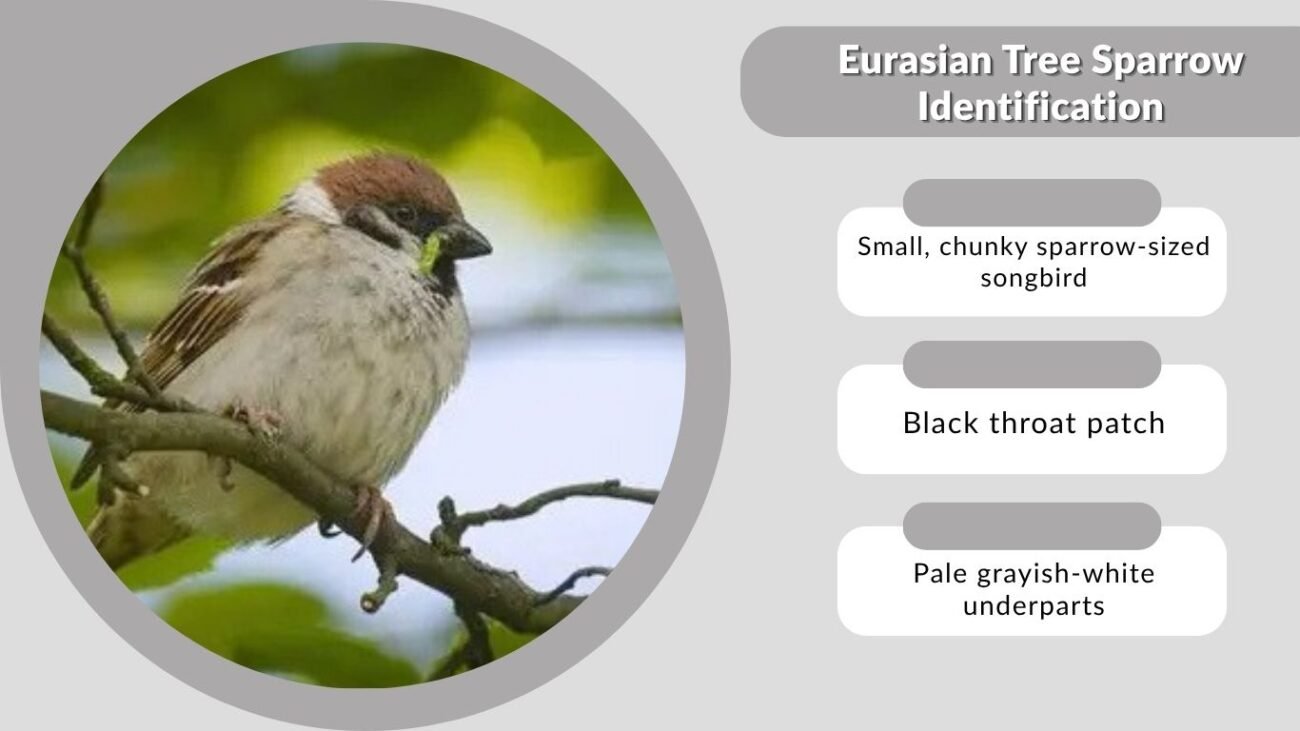
The Eurasian Tree Sparrow has a neat, distinctive look. Unlike the House Sparrow, both males and females look very similar. That means a “male Eurasian tree sparrow bird” and a female usually show the same main field marks.
Key Identification Features
- Small, chunky sparrow-sized songbird
- Chestnut-brown crown or cap
- White cheek with a black cheek spot
- Black throat patch
- Rich brown upperparts with dark streaking
- Pale grayish-white underparts
- Short neck and rounded head
- Thick, cone-shaped bill for seeds and grains
Cornell describes the bird as a small, somewhat chubby songbird with a rounded head, short neck, and thick conical bill. Adults have a chestnut cap, black face markings, black spot in the white cheek, brown streaked upperparts, and pale underparts.
Size
The Eurasian Tree Sparrow is slightly smaller than a House Sparrow. Its length is about 5.5–5.9 inches or 14–15 cm, with a wingspan of about 7.9–8.7 inches.
| Feature | Eurasian Tree Sparrow |
| Scientific name | Passer montanus |
| Family | Passeridae |
| Length | 5.5–5.9 in / 14–15 cm |
| Weight | 0.6–1.0 oz / 18–28 g |
| Wingspan | 7.9–8.7 in / 20–22 cm |
| Main field mark | Black cheek spot on white cheek |
Eurasian Tree Sparrow vs House Sparrow
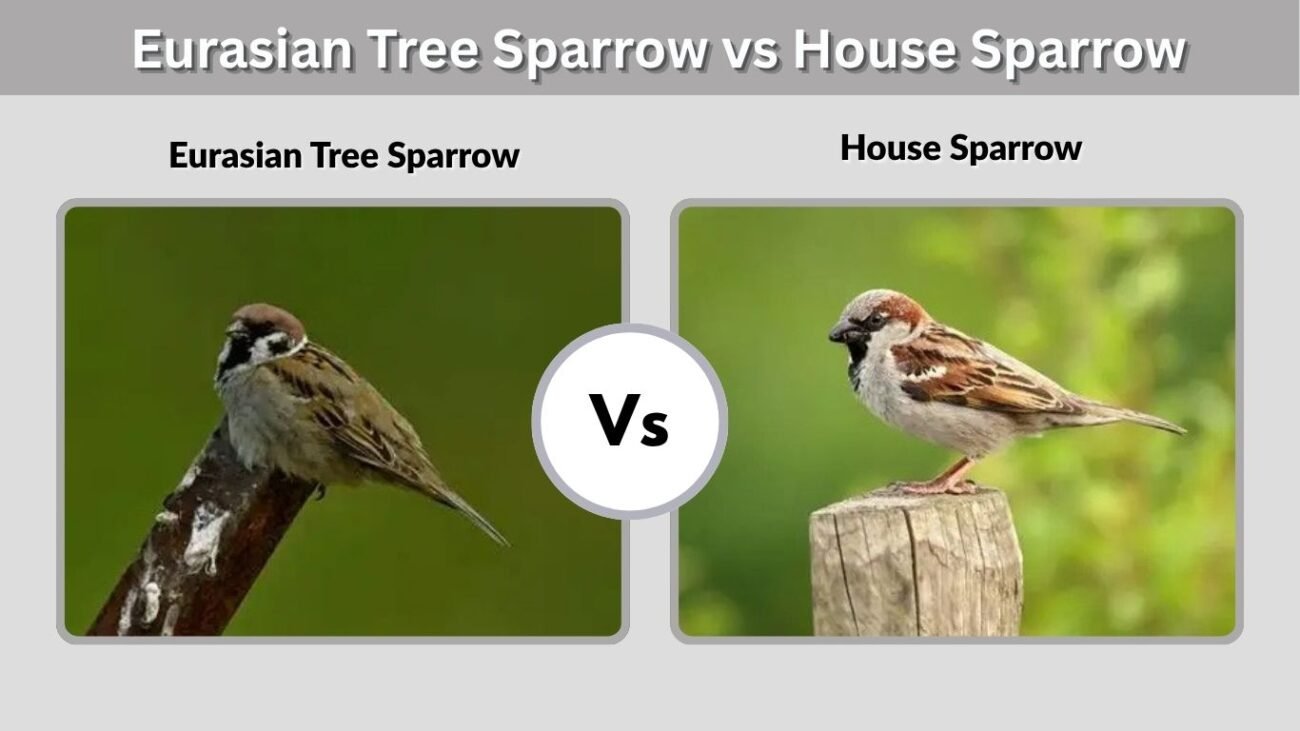
The House Sparrow is the bird most often confused with the Eurasian Tree Sparrow. Both are Old World sparrows, both live near people, and both have brown, gray, and black markings. The easiest difference is the cheek. Eurasian Tree Sparrows have a clear black spot on a white cheek; House Sparrows do not show that same clean cheek spot.
| Feature | Eurasian Tree Sparrow | House Sparrow |
| Cheek | White cheek with black spot | No bold black cheek spot |
| Crown | Chestnut-brown cap | Male has gray crown; female is plainer |
| Sexes | Male and female look similar | Male and female look different |
| Size | Slightly smaller | Slightly larger |
| Habitat | Farms, parks, villages, hedgerows | Cities, towns, farms, buildings |
In Singapore bird references, the Eurasian Tree Sparrow is separated from the male House Sparrow by its smaller size, browner underparts, chestnut cap, and dark cheek patch. Female House Sparrows are duller and lack the Eurasian Tree Sparrow’s strong cap and bib pattern.
Eurasian Tree Sparrow Habitat and Range
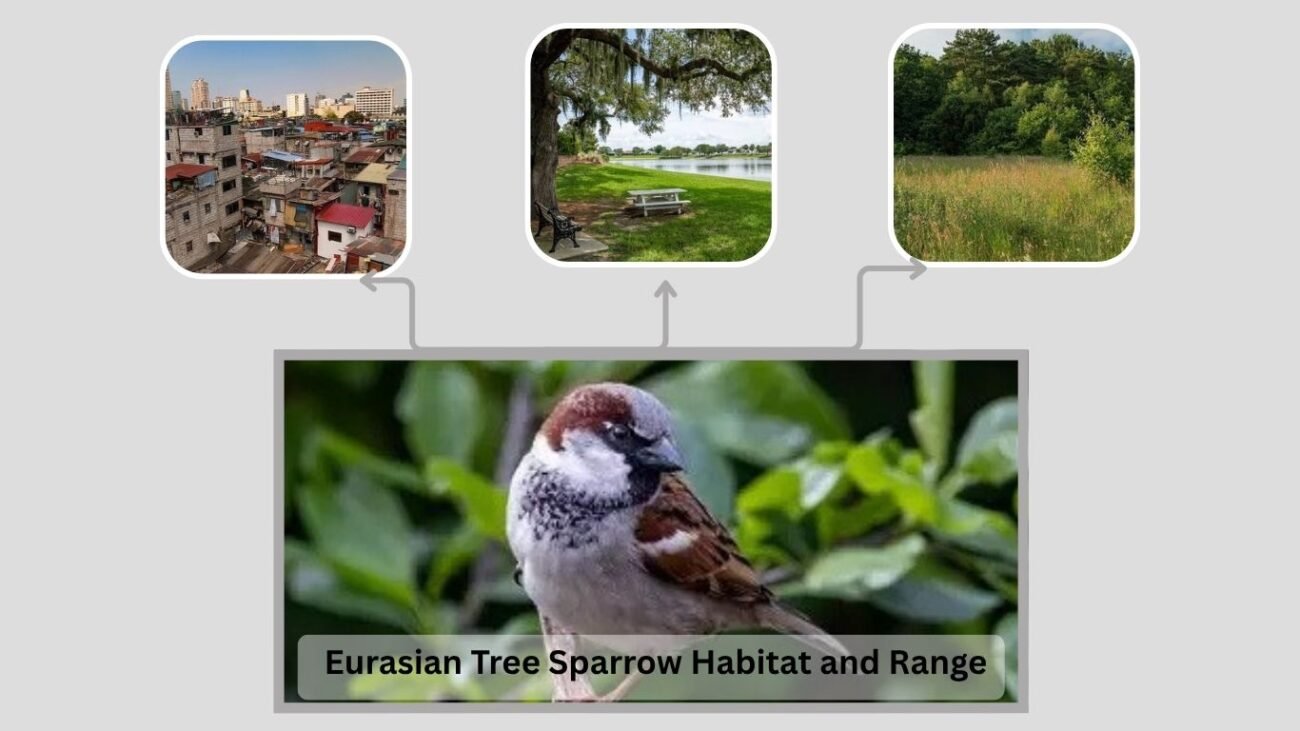
The Eurasian Tree Sparrow is widespread across Europe and Asia. In many parts of its natural range, it is a familiar bird of open country, villages, farms, parks, gardens, and human-influenced landscapes. In Singapore, it is listed as widespread and very common, often using open habitats, urban areas, parks, grasslands, and fields.
In North America, its range is much more limited. Cornell explains that birds from Germany were released in St. Louis, Missouri, in 1870. Those birds spread into northeastern Missouri, west-central Illinois, and southeastern Iowa.
Eurasian Tree Sparrow Birds of Missouri
Missouri is the most important U.S. state for this species. The Missouri Department of Conservation lists the Eurasian Tree Sparrow as a nonnative, common permanent resident introduced in St. Louis in 1870. Its range has expanded from the St. Louis area, especially northward.
In Missouri, birders may look for it around residential edges, farms, grain areas, hedgerows, and lightly wooded neighborhoods. The species is especially associated with the St. Louis region and nearby areas.
Eurasian Tree Sparrow St. Louis Birds
St. Louis is central to the North American story of this bird. The original North American population began when a small number of European birds were released there in the 1800s. The Missouri Department of Conservation notes that the descendants of the original 12 birds number about 15,000 individuals today.
The bird did not spread across the continent like the House Sparrow. One reason is competition with the larger and more aggressive House Sparrow, which pushed Eurasian Tree Sparrows more toward residential and rural habitats.
Eurasian Tree Sparrow Birds of Minnesota
In Minnesota, the Eurasian Tree Sparrow is not a common everyday bird. The Minnesota Ornithologists’ Union records show scattered reports, including a first state record in 1990, a second state record in 1998, and additional later records from counties such as Dakota, Clay, Hennepin, St. Louis, Lake, Polk, and others.
This means Minnesota sightings are notable and often attract birders. Anyone searching for “Eurasian tree sparrow birds of Minnesota” is likely looking for rare or unusual records rather than a widespread breeding bird.
Eurasian Tree Sparrow Birds Singapore
In Singapore, the Eurasian Tree Sparrow is much more familiar. Birds of Singapore lists it as a very common resident, widespread across Singapore, and often associated with people. Its local subspecies is listed as malaccensis, and its size is given as about 14–14.5 cm.
In Singapore, this bird may be seen in parks, grasslands, fields, urban areas, and other open habitats. It often gathers in flocks and feeds mainly on the ground, though it also forages in plants and trees.
What Does the Eurasian Tree Sparrow Eat?
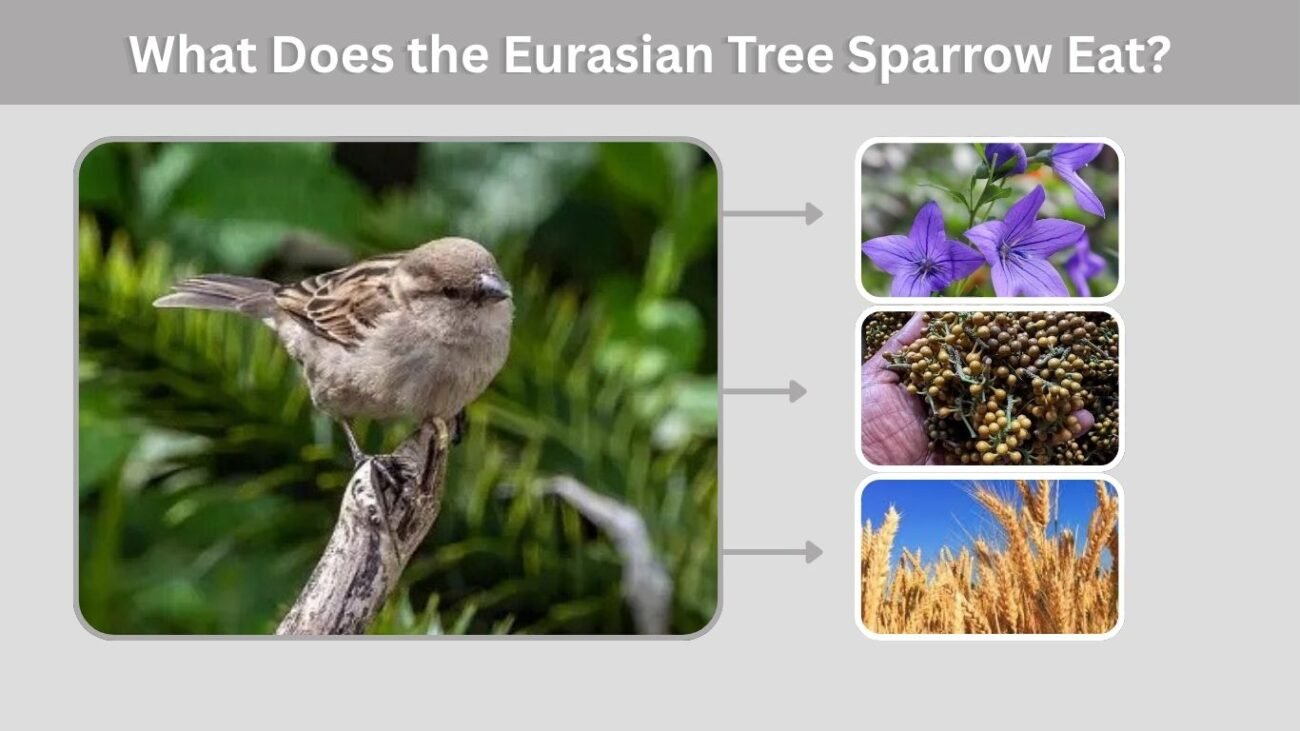
The Eurasian Tree Sparrow eats a mixed diet of seeds, grains, fruits, flowers, and invertebrates. It often forages on the ground, in grasses, bushes, and lower tree branches. In agricultural areas, it may eat grains such as oats, rye, wheat, corn, sunflower, and sorghum.
During spring, insects and other arthropods become especially important, particularly when adults are feeding young. Cornell also notes that the species may eat berries, flowers, leaf buds, and new shoots.
Eurasian Tree Sparrow Nesting and Eggs
Eurasian Tree Sparrows are cavity nesters. Males may choose cavities in trees, buildings, poles, fence posts, or nest boxes. Most nests are placed more than 3 feet and less than 30 feet above the ground.
Both male and female build the nest. It is usually made from grass, straw, roots, and similar plant material, then lined with softer items such as feathers, hair, cloth, string, and plant matter. The clutch usually contains 4–7 eggs, which are white to pale gray and marked with spots or speckling.
Behavior and Flocks
Eurasian Tree Sparrows are social birds. They may forage alone, in small groups, or in larger flocks, especially outside the breeding season. Cornell notes that they gather into flocks from fall through early spring and may forage and roost communally.
During courtship, males sing from nest sites and display by fluffing their feathers, moving their wings and tail, and inviting females to inspect nest cavities. Pairs form in the first breeding season and often remain together if both birds survive.
Conservation Status
Globally, the Eurasian Tree Sparrow is not considered a high conservation concern. Cornell lists it as a species of low conservation concern, while Birds of Singapore cites BirdLife International’s Least Concern status.
However, local abundance can vary greatly. In Singapore, it is very common, while in North America it remains limited mainly to the St. Louis region and nearby areas.
FAQs
Is the Eurasian Tree Sparrow the same as a House Sparrow?
No. The Eurasian Tree Sparrow and House Sparrow are related Old World sparrows, but they are different species. The Eurasian Tree Sparrow has a chestnut cap and a clear black cheek spot on a white cheek. House Sparrows lack that same bold cheek mark.
Where can you find Eurasian Tree Sparrows in the United States?
In the United States, Eurasian Tree Sparrows are mainly associated with the St. Louis, Missouri region and nearby parts of Illinois and southeastern Iowa. They came from birds introduced in St. Louis in 1870.
Are Eurasian Tree Sparrows common in Singapore?
Yes. In Singapore, the Eurasian Tree Sparrow is listed as a very common resident and is widespread across the country. It uses open habitats, parks, urban areas, grasslands, and fields, often near human activity.
Do male and female Eurasian Tree Sparrows look different?
Male and female Eurasian Tree Sparrows look very similar. Both show the chestnut cap, white cheek, black cheek spot, and black throat area. This is different from House Sparrows, where males and females have noticeably different plumage.
What is the easiest way to identify a Eurasian Tree Sparrow?
The easiest field mark is the black spot on the white cheek, combined with a chestnut-brown crown and small sparrow-like body. If the bird has these marks and looks slightly smaller than a House Sparrow, it may be a Eurasian Tree Sparrow.