











The ostrich, the world’s largest bird, is also nature’s fastest runner on two legs. Despite being flightless, it can sprint across the African plains at breathtaking speeds. Known for its powerful legs and long strides, this bird uses speed as its main defense against predators. In this article, we’ll explore just how fast an ostrich can run, the science behind its power, and how it compares to other runners on land.
Ostrich Overview and Speed Capabilities
The World’s Fastest Bird on Land
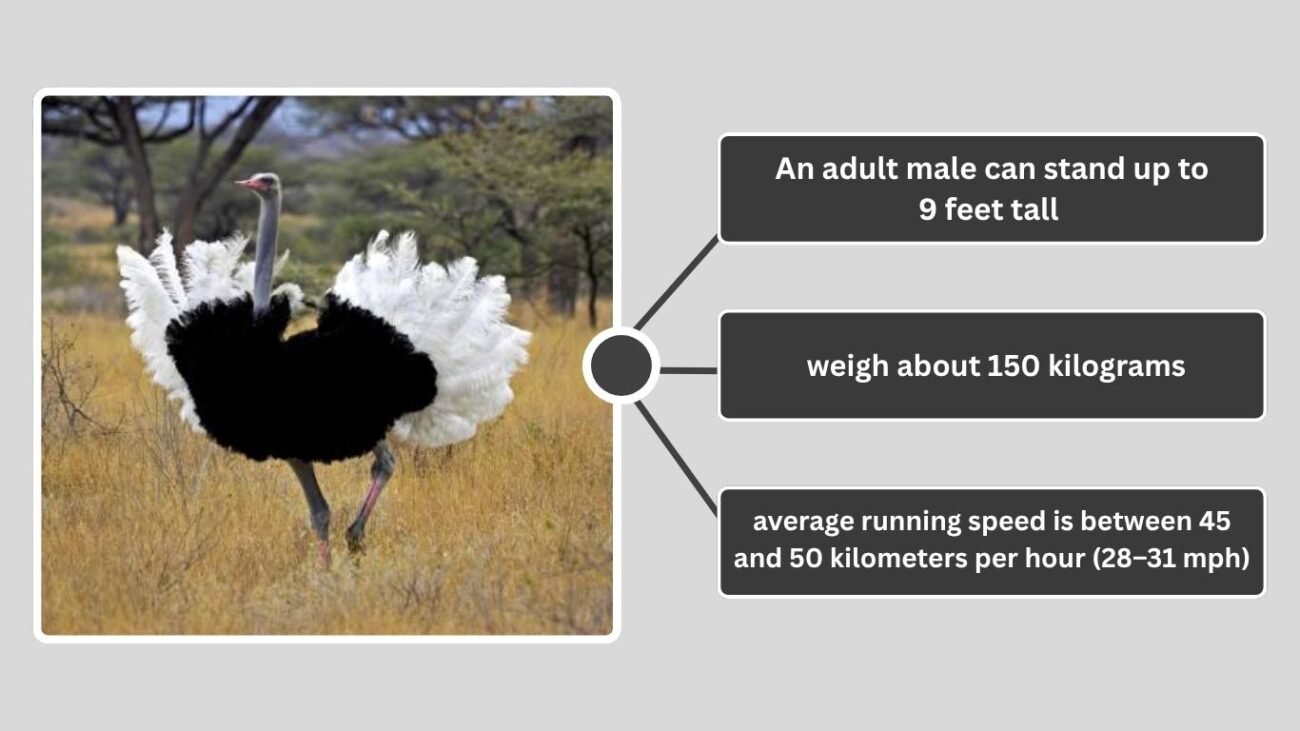
The ostrich (Struthio camelus) holds the title of the fastest-running bird and the largest living bird species. Native to Africa, it thrives in open savannas and deserts, where speed is vital for survival. An adult male can stand up to 9 feet tall and weigh about 150 kilograms, yet it runs faster than most animals its size.
Average and Top Speeds
An ostrich’s average running speed is between 45 and 50 kilometers per hour (28–31 mph), but when threatened, it can reach top speeds up to 70 kilometers per hour (43 mph). Their acceleration is equally impressive—they can go from a standstill to full sprint in just a few seconds. Unlike many animals that rely on bursts of speed, ostriches can sustain high speeds over long distances, making them exceptional endurance runners.
Physical Adaptations That Enable Speed
Powerful Legs and Long Stride
The secret to an ostrich’s speed lies in its incredible leg strength. Each leg has only two toes, which reduces drag and increases efficiency. The larger toe has a thick claw that provides grip, while the smaller one helps balance. Their muscular thighs and long tendons act like springs, storing and releasing energy during each stride. With a single step reaching up to 5 meters (16 feet), ostriches cover ground quickly and smoothly.
Efficient Balance and Lightweight Build
Despite their large size, ostriches maintain excellent balance. Their long neck and small head act as counterweights, keeping the body stable while running at high speed. Their relatively light skeleton and air-filled bones reduce body mass, allowing them to move swiftly without heavy lifting effort.
Endurance vs. Sprinting Ability
Unlike cheetahs that tire quickly, ostriches combine speed with endurance. They can maintain around 40 kilometers per hour (25 mph) for up to 15–20 minutes, enabling them to escape predators over long distances. Their large lungs and efficient heart supply muscles with oxygen, preventing early fatigue.
Ostrich Speed in Different Measurements
Speed in Miles per Hour (mph)
For those who prefer imperial units, an ostrich’s top speed is approximately 43 mph. That’s faster than most horses at a gallop and nearly double the average running speed of a human sprinter. Even at a steady pace of 30 mph, an ostrich can easily outdistance predators such as lions or hyenas in an open chase.
Speed in Kilometers per Hour (km/h)
In metric terms, ostriches typically run between 45 and 70 km/h, depending on age, fitness, and terrain. Young ostriches can also reach remarkable speeds, though they often tire more quickly. These figures have been verified by field researchers using GPS tracking and motion analysis, confirming that the ostrich is indeed the fastest bird on land.
Speed Over 100 Meters, One Mile, and Marathon Distance
If we translate their speed into human race comparisons, the results are astonishing. At their top velocity, an ostrich could run 100 meters in just about 5–6 seconds, beating world records held by elite athletes like Usain Bolt. Over a mile, an ostrich could finish in around 1 minute and 25 seconds. However, like sprinters, maintaining such a pace over marathon distances isn’t possible; they would instead switch to a slower, more sustainable trot around 25 mph (40 km/h).
Species and Regional Differences
African Ostrich Speed
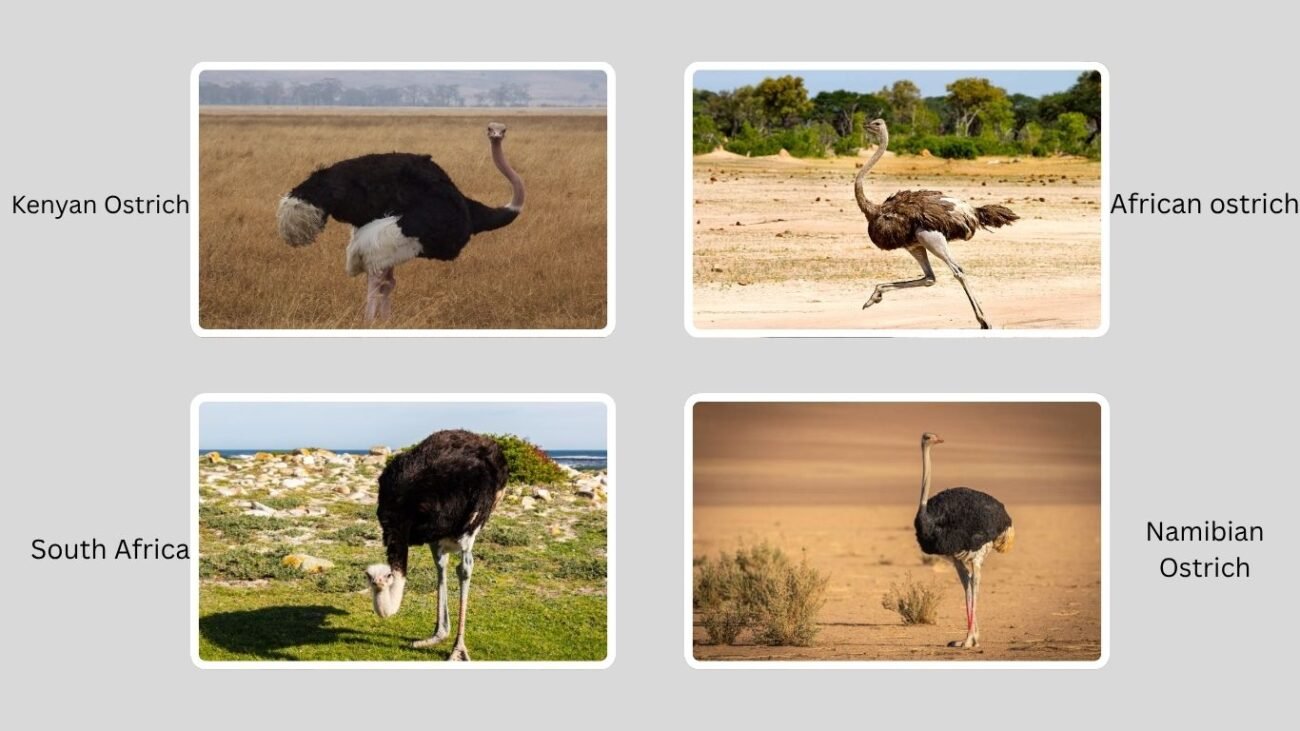
The African ostrich (Struthio camelus), found across regions like Kenya, Namibia, and South Africa, is the fastest of all ostrich subspecies. Its strong muscles and long limbs evolved perfectly for life in wide, open landscapes. This adaptation allows it to sprint across rough terrain without losing momentum or stability.
Comparing Subspecies and Environmental Factors
Other subspecies, such as the Somali ostrich or the Masai ostrich, show slight variations in size and leg proportion, affecting their maximum speed. Environmental conditions like soft sand, rocky plains, or extreme heat can also impact performance. For instance, ostriches in cooler climates can maintain higher endurance, while those in hotter zones often limit sprinting to short bursts to avoid overheating.
Ostriches Running with Riders
Historically, ostriches have fascinated humans with their speed and strength. In some African regions and early zoos, people attempted to ride them, leading to the novelty sport of ostrich racing. However, while ostriches can carry light loads briefly, riding significantly slows them down. Their anatomy is not built to support heavy weight on the back—doing so causes imbalance and stress on the legs. Modern animal welfare laws now discourage such practices, recognizing that ostrich riding can harm the bird’s health.
How Ostriches Maintain High Speed
Biomechanics and Motion Pattern
Ostriches use a unique running motion that maximizes speed and efficiency. Their gait alternates between long aerial leaps and powerful ground pushes. With every stride, they momentarily lift both feet off the ground — a movement similar to galloping mammals. Their elastic tendons act like natural springs, storing energy and releasing it in the next step. This minimizes muscle fatigue and helps them maintain speed with less effort.
Muscle Composition and Oxygen Use
The ostrich’s leg muscles are made up of both fast-twitch and slow-twitch fibers, giving it a perfect balance of power and stamina. Its large lungs and air sacs allow for steady oxygen intake, cooling the body during long sprints. Combined with efficient blood circulation, this ensures high performance even in the intense African heat.
Distance and Endurance
Ostriches can run at moderate speeds for surprisingly long distances. While they reach peak speeds only for short bursts, they can maintain around 40–45 km/h (25–28 mph) for 10 to 15 miles when escaping predators or migrating between feeding areas. This endurance makes them one of the few birds capable of sustained high-speed travel without rest. Their energy-efficient anatomy allows them to cover great distances without overheating or muscle strain.
Ostrich Speed Compared to Other Animals
Versus Human Sprinters
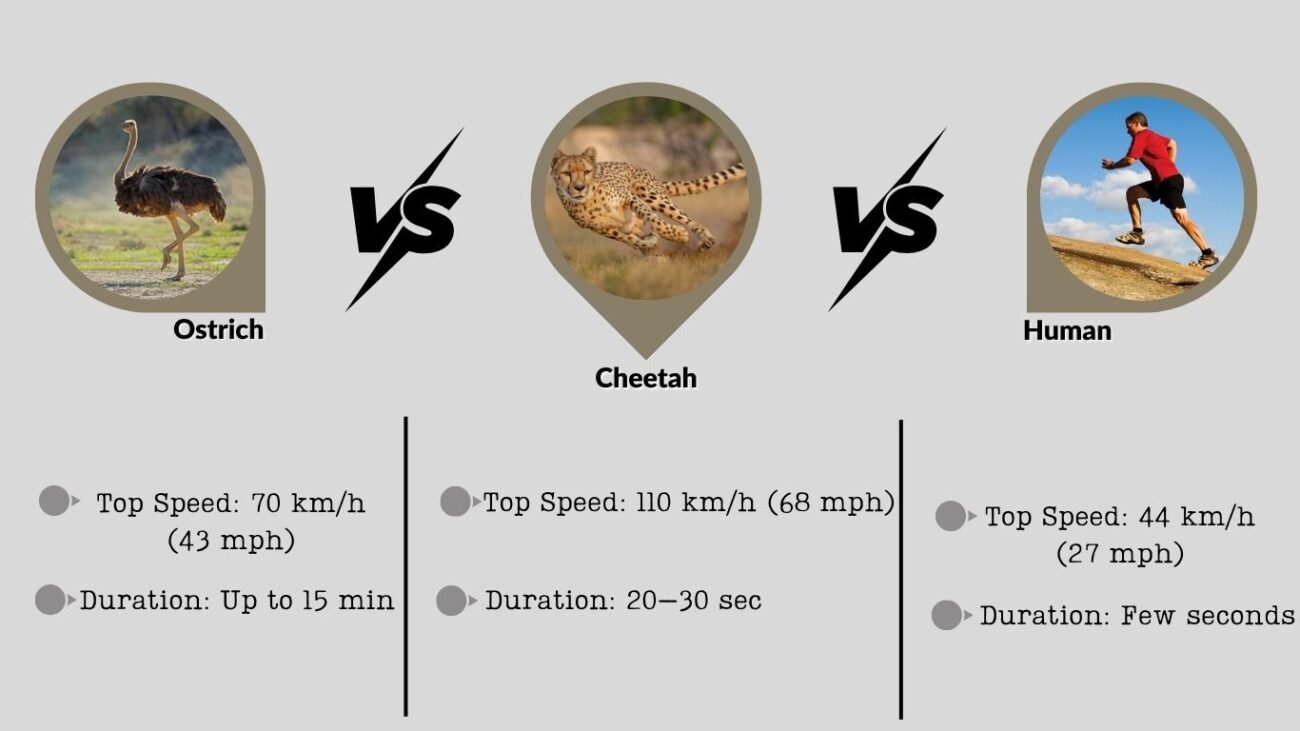
The fastest recorded human, Usain Bolt, reached 44 km/h (27.8 mph) over 100 meters. An ostrich, however, can run almost twice that speed, maintaining it far longer. If humans competed against ostriches on a racetrack, even elite sprinters would fall behind within seconds.
Versus Other Land Animals
While not as fast as a cheetah, the ostrich stands out for its balance of speed and endurance. Cheetahs can reach 110 km/h but only for 20–30 seconds. Ostriches, on the other hand, can maintain half that speed for many minutes.
| Animal | Top Speed | Duration | Notes |
| Ostrich | 70 km/h (43 mph) | Up to 15 min | Fastest bird on land |
| Cheetah | 110 km/h (68 mph) | 20–30 sec | Short bursts only |
| Horse | 88 km/h (55 mph) | Several minutes | Excellent stamina |
| Human (Bolt) | 44 km/h (27 mph) | Few seconds | Record sprint |
| Emu | 48 km/h (30 mph) | Short bursts | Australia’s fastest bird |
This comparison highlights the ostrich’s remarkable position as a balance between sprinter and marathoner — neither the fastest overall nor the strongest, but the most enduring of all birds.
Interesting Facts and Myths About Ostrich Speed
Ostriches don’t just run fast — they do it with intelligence and strategy. When chased, they zigzag to confuse predators and use sudden direction changes to their advantage. Contrary to myths, ostriches do not bury their heads in sand. When they lower their heads, they’re usually inspecting the ground or hiding from distant threats.
In ancient times, ostriches symbolized speed and power in African and Middle Eastern cultures. Even today, ostrich feathers are used in ceremonial costumes to represent swiftness and grace.
Videos and Observation in the Wild
Modern research on ostrich locomotion uses GPS trackers and radar systems to study their running efficiency. Wildlife documentaries often capture ostriches sprinting across open savannas — a breathtaking sight that demonstrates how evolution optimized their every movement. Observing these birds in natural habitats, like Kenya’s Maasai Mara or Namibia’s deserts, gives scientists insights into how endurance and agility protect them from predators.
FAQs
How fast can an ostrich run at top speed?
An ostrich can sprint up to 70 kilometers per hour (43 miles per hour), making it the fastest bird on land. It uses powerful leg muscles and long strides to reach this impressive speed, often outpacing large predators like lions or hyenas in open chases.
How long can an ostrich maintain its top speed?
While ostriches can reach top speed for only 15–30 seconds, they can sustain speeds around 40–45 km/h (25–28 mph) for several minutes. This endurance helps them travel long distances and evade threats without quickly tiring.
Is the African ostrich faster than other subspecies?
Yes, the African ostrich (Struthio camelus) is the largest and fastest of all ostrich species. Its strong muscles, long limbs, and open habitat give it an evolutionary edge compared to other subspecies like the Somali ostrich.
Can humans ever outrun an ostrich?
No, even the fastest human sprinters cannot outrun an ostrich. The bird’s top speed of 43 mph nearly doubles that of Usain Bolt. Its ability to maintain high velocity over long distances makes it unbeatable on land among bipeds.
Why do ostriches run instead of flying?
Ostriches are flightless due to their large bodies and small wings, but evolution compensated with exceptional running ability. Their strong legs and lightweight structure allow them to cover vast distances quickly, making running their main form of defense and travel.


